

TUV Class 0 Oil-Free Air Compressor Delivers 24/7 Continuous Operation
2026-11-16
What would your operation look like if your compressor never stopped and your air stayed completely oil-free? With the TUV Class 0 oil-free compressor from Seize Air, that’s no longer hypothetical—it’s a 24/7 reality.
Zero Oil, Zero Worry for Sensitive Applications
When compressed air touches a pharmaceutical batch or a wafer in a cleanroom, even a trace of oil becomes a critical contaminant. Oil-free systems remove that variable entirely, so there is no lubricant to leak past seals, no residue to accumulate in lines, and no risk of batch rejection caused by carryover. For facilities that answer to strict audits, this shifts the conversation from constant monitoring to confident operation.
Maintenance habits change too. Instead of checking oil levels, changing filters, and disposing of oily condensate, teams can focus on other priorities. Fewer consumables mean less waste, fewer replacement parts, and a cleaner work environment. That simplicity often translates into lower lifetime costs, even before you count the value of avoiding a single contamination event.
In sensitive processes, worry usually hides in the details: an aging separator, a forgotten drain, a slow buildup inside a pipe. Oil-free equipment removes the source rather than managing the symptom. It gives engineers one less thing to second-guess, which is exactly what a high-stakes application needs.
What TUV Class 0 Certification Actually Verifies
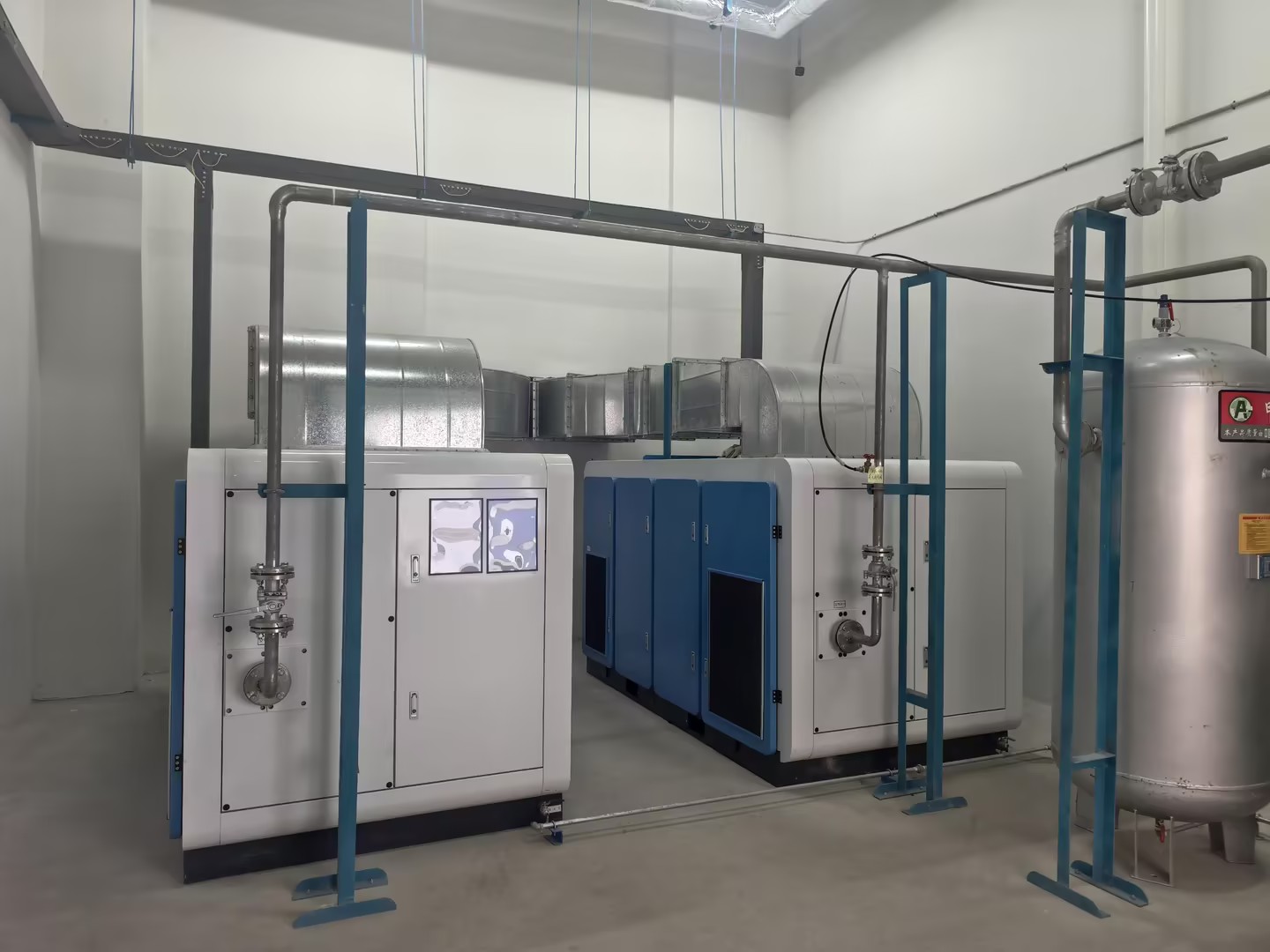
TUV Class 0 certification goes far beyond basic electrical safety checks. It confirms that the power supply can operate continuously at full rated load without any degradation in performance or lifespan, even when constantly energized. This means the unit has been tested to withstand prolonged thermal stress, voltage fluctuations, and switching transients without drifting outside its specified output tolerances. In practice, it verifies that the design uses high-grade components and proper thermal management, so there is no need for periodic derating or forced cooling under normal operating conditions.
The certification also scrutinizes insulation integrity and clearance distances under worst-case fault scenarios, ensuring no risk of electric shock or fire even if a single component fails. It checks that the unit can handle inrush currents and repetitive power cycling without weakening solder joints or degrading capacitors. Unlike lower classes, Class 0 does not allow any compromise on creepage or air gap distances, which is critical in humid or polluted environments. This rigorous verification means the power supply can be embedded in devices where access for maintenance is impossible or where failure could lead to hazardous situations.
Furthermore, TUV Class 0 verifies long-term reliability through accelerated life testing and thermal cycling. The unit is subjected to repeated temperature swings from minimum to maximum rated ambient, followed by full-load operation at elevated temperatures. Only designs that show no measurable drift in output voltage, ripple, or efficiency after these stress tests receive the certification. This is why Class 0 is often mandatory for medical devices, industrial controls, and safety systems—applications where downtime or unpredictable behavior is not an option.
Building a Compressor for Nonstop Duty
Designing a compressor for nonstop duty starts with accepting that every component will see more thermal cycles in a single year than a standard machine sees in its entire life. The cylinder bores and piston rings are machined to slightly different tolerances, so that after the first few hundred hours of heat expansion, they settle into a near-perfect seal instead of wearing themselves into excessive clearance. Valve plates are specified from a hardened alloy that resists fretting, and the unloaders are set to cycle only when the demand signal drops below a threshold that avoids short-cycling the motor.
Lubrication becomes a thermal management problem rather than a simple maintenance task. A full-pressure oil circuit with a generously sized cooler and a dual-stage filtration loop keeps the oil viscosity inside the operating window even when the ambient temperature swings by thirty degrees between shifts. The crankcase breather is routed to a coalescing separator to cut down on oil mist escaping into the plant air, which in turn reduces the need to top up the sump during extended runs.
The final proof is in the endurance test, not the spec sheet. A nonstop-duty unit is run at full load for thousands of hours with periodic vibration spectral analysis looking for any bearing frequency shift that would indicate a developing fault. Only when the temperature rise across the intercooler stays flat and the power draw remains within two percent of baseline does the compressor get approved for continuous operation.
How 24/7 Operation Changes the Design Equation
When equipment runs without interruption, thermal cycling is no longer a gentle daily swing but a continuous accumulation of micro-stresses. Designers must discard assumptions built around an eight-hour workday and re-derive fatigue life formulas. A power module rated for ten years under normal duty might fail early in 24/7 service due to sustained ripple current in electrolytic capacitors. The design equation thus needs stricter derating factors and accounts for accelerated aging at constant elevated temperatures.
Continuous operation also squeezes maintenance windows to the extreme. Planned downtime becomes unacceptable, so the system must support online replacement of critical components. This directly reshapes the mechanical structure and electrical architecture: redundancy is no longer an option but a constant in the equation. Fans, power supplies, and storage devices need to be hot-swappable modules, with failover times short enough to be invisible to users. The design equation shifts from mean time between failures to the product of mean time to repair and availability.
Moreover, energy consumption and heat dissipation under 24/7 running become a persistent cost. Unlike intermittent machines that shed heat during idle periods, continuously operating gear demands more aggressive thermal design—lower contact resistance, more efficient heat paths, or even liquid cooling. In the design equation, the product of thermal resistance and power dissipation is no longer a transient peak value but a steady-state average over long periods. This forces engineers to run thermal simulations early, because late-stage rework becomes prohibitively expensive.
Maintenance Without the Messy Oil Changes
Routine upkeep no longer means wrestling with drain plugs, hot oil splatter, and stale rags. Many modern machines and vehicles now use cartridge-style filters or top-mounted extractors that pull old oil out through the dipstick tube, leaving the garage floor spotless.
For those who prefer a hands-off approach, sealed lubrication systems and extended-life synthetic fluids stretch service intervals far beyond the old 3,000-mile rule. You simply check condition, top off if needed, and let the system handle the rest.
Even when a full change is required, a few simple tools like a fluid evacuator and a disposable liner can turn a messy chore into a ten-minute task. The days of crawling under a dripping engine are optional, not inevitable.
Air Purity That Keeps Production Moving
In precision manufacturing, even a few microscopic particles drifting through the air can settle on sensitive components, causing short circuits or surface defects that halt an entire batch. Oil vapor from compressors or moisture from ambient humidity often goes unnoticed until a downstream process starts rejecting parts. These silent interruptions are rarely traced back to air quality, yet they account for a significant share of unplanned downtime.
The most effective way to prevent these issues is not simply adding another filter, but designing a purification train that matches the specific contaminants in your facility. Coalescing filters remove oil aerosols, desiccant dryers handle moisture, and high-efficiency particulate arrestance captures submicron dust. Continuous monitoring of pressure differentials and dew point alerts operators before any contaminant breakthrough occurs, keeping the compressed air supply within tight purity limits.
When air purity becomes a controlled variable rather than an assumption, production lines keep moving without the frequent stops for cleaning or recalibration. Maintenance teams shift from reactive repairs to scheduled inspections, and quality control no longer wastes time investigating mystery defects that trace back to the same root cause. The result is a steady throughput that supports delivery commitments and reduces scrap rates in ways that show up directly on the bottom line.
FAQ
It certifies that the compressed air contains no detectable oil carryover, meeting the strictest purity class under ISO 8573-1. That makes it safe for processes where even trace oil would ruin product quality.
Yes, its oil-free design removes the need for oil changes and the associated downtime, while the cooling and drive components are built for continuous duty. Many users keep it running around the clock with only basic scheduled inspections.
Without oil in the air end, there is no risk of oil degradation, clogged filters, or thermal breakdown that often forces shutdowns in lubricated units. It also means fewer consumables and a simpler cooling path.
Food and beverage, pharmaceutical, electronics, and textile plants rely on it the most because any oil contamination can lead to rejected batches or equipment damage. In those settings, continuous clean air is a production requirement, not a luxury.
Mostly filter replacements, checking condensate drains, and inspecting cooling fans or water lines. Since there is no oil to sample or change, the routine is lighter than with lubricated compressors, but scheduled checks remain essential.
Good continuous-rated models are designed with oversized coolers, thermal protection, and durable bearings to handle constant load. As long as ambient conditions and ventilation are within spec, overheating should not be a limiting factor.
A lubricated compressor can deliver clean air only with extensive filtration and still carries some risk of oil carryover. The oil-free Class 0 unit eliminates that risk at the source, so it supports long shifts with less monitoring and fewer contamination concerns.
The certification applies to the compressor model under defined test conditions, but real-world performance depends on proper installation and maintenance. Periodic air quality tests are still recommended to confirm the system stays within Class 0 limits.
Conclusion
Running a production line around the clock leaves no room for contaminated air. That's why a TUV Class 0 oil-free compressor matters: the certification isn't just a label, it's third-party proof that no oil mist or liquid oil reaches the air stream. TUV's testing goes beyond typical manufacturer claims, simulating prolonged operation at elevated temperatures and monitoring for any oil carryover down to parts per billion. For food packaging, pharmaceutical coating, electronics assembly, or medical air, even trace oil can ruin batches or trigger recalls. This machine eliminates that risk by design, using coated rotors, water-lubricated bearings, and sealed paths that never mix lubricant with compressed air.
But purity alone isn't enough when your plant never stops. Continuous 24/7 duty forces different choices: oversized coolers, reinforced drive trains, and control algorithms that prevent thermal fatigue. The result is a compressor that handles variable demand without tripping or overloading. Maintenance also changes dramatically. Instead of draining oil, replacing filters, and disposing of hazardous waste, you only deal with condensate and simple wear parts, which cuts downtime and keeps the air supply consistent. Unlike oil-lubricated units that need frequent oil sampling and filter replacements, this design removes those failure points entirely, letting maintenance teams focus on predictable tasks instead of emergency repairs. That reliability, combined with verified Class 0 purity, is what keeps sensitive production moving shift after shift.
Contact Us
Contact Person: Mia
Email: [email protected]
Tel/WhatsApp: +86 19821985894
Website: https://www.seize-air.com