
Top Agricultural Drone Training Simulator to Elevate Your Precision Farming Skills
2026-08-26
Mastering agricultural drone operation isn't just about flying—it's about reading crop health, adjusting spray patterns on the fly, and making decisions that directly affect yield. Yet too many training programs still rely on expensive real-world trial runs or clunky simulations that feel nothing like actual field conditions. That gap is exactly where a purpose-built simulator can accelerate your learning curve. SRIZFLY has stepped in with a training environment that mirrors real flight dynamics, variable terrain, and shifting weather, so every practice session builds muscle memory you can trust. Whether you're an experienced agronomist or just starting with drone-assisted farming, the right simulator can turn months of guesswork into focused, measurable progress. Below, we'll explore what makes a training tool truly effective—and why SRIZFLY is quickly becoming the preferred choice for operators serious about precision agriculture.
Why Your First Real Flight Shouldn't Be Your First Time at the Controls
There's a stubborn myth in aviation that a discovery flight should also be your first time touching a yoke or rudder pedals. That assumption sets you up for sensory overload. A cockpit is loud, the radio chatter doesn't pause for your nerves, and the instructor's voice competes with engine noise. If your hands are learning what "pitch" and "bank" feel like for the very first time, your brain has almost no bandwidth left to notice the horizon, the traffic pattern, or the tiny corrections that keep the airplane coordinated. You end up surviving the lesson instead of actually tasting it.
Spending a few hours with a desktop flight simulator, or even running through the motions in a parked airplane, changes the texture of that first real flight. You don't need to master anything. You just need the controls to feel familiar enough that your eyes can stay outside the window. When the instructor says "your airplane," you're no longer fighting the joystick; you're finally free to listen to the engine, feel the bumps in the air, and start building the instincts that actually matter.
Some pilots worry that sim time teaches bad habits. It can, if you treat it like a video game. But used as a way to preview the physical layout and the rhythm of flight, it strips away one layer of novelty. That leaves more room for the real lesson: watching the nose settle on the horizon, learning what the rudder does to your shoulders, and figuring out why the airplane wants to climb when you turn. Let your first time at the controls be a rehearsal, not a debut.
The Simulator Features That Actually Matter for Crop Work
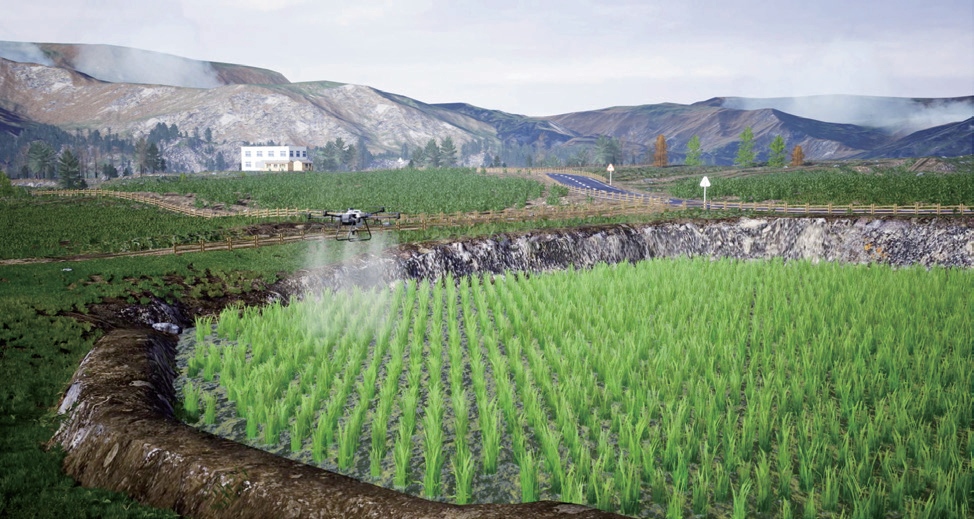
Most crop work simulators nail the paint job but miss the way a three-point hitch actually behaves under load. When you drop a chisel plow into hard ground, the rear of the tractor should squat, the rpm should dip, and the draft control should hunt for a steady depth instead of locking instantly. That kind of feedback tells you whether you're working too deep or too fast long before a yield map does.
Soil moisture and compaction aren’t just visual filters. They change how much slip you get at the drive wheels, which changes fuel burn and how straight your rows stay on a sidehill. A simulator that ignores this turns every field into a parking lot. The useful ones make you feel the difference between loose sandy loam and wet clay after a rain, and they punish you for running duals when singles would float better.
The crop itself has to give you usable signals. Lodged wheat, green stems, overripe pods that shatter at the header—these are the details that decide whether you harvest now or wait another day. If the simulator only shows a uniform texture change and a percentage bar, it’s not helping you plan. You want to see the canopy lean, hear the rotor groan under a damp swath, and watch the grain tank fill unevenly because the field wasn’t sprayed on time.
Learning to Read Plant Health from the Air Before You Fly
The real skill isn't in the drone or the camera—it's in knowing what the colors, patterns, and subtle shifts in a field actually mean before you ever leave the ground. A dark green patch next to a pale, washed-out strip might be a drainage issue, not a nutrient problem. Learning to read those clues from satellite layers or previous flight maps helps you plan a flight that targets the right spots instead of wandering over acres of healthy crop.
Start by comparing historical growth patterns with the current season's early imagery. Look for inconsistencies: a section that was uniform last year but now shows ragged edges, or a low spot that always dries out faster than the surrounding rows. These aren't just anomalies—they're stories the land tells you about root depth, compaction, or even a slow leak in an irrigation line. The more you practice this kind of ground-truthing with existing aerial data, the sharper your eye gets before the propellers even spin up.
Eventually, you'll develop a mental checklist that turns a simple flyover into a focused diagnostic pass. Instead of asking "what's wrong here," you'll already have a shortlist of suspects: nitrogen stress in sandy pockets, early fungal pressure along the tree line, or a planter skip that never got filled in. That kind of pre-flight reading doesn't just save battery life—it changes the whole conversation with the grower, because you're not bringing back questions. You're bringing back answers that were waiting to be seen from above.
Wind, Terrain, and Battery: Rehearsing the Unpredictable
Wind is never a steady number on a weather app. It curls around buildings, drops into narrow alleys, and gusts without much warning. A machine that performs perfectly indoors can look clumsy when a 25-knot crosswind hits a blind corner. Rehearsing means flying or driving the same route over and over, not to memorize it, but to build a feel for how sudden pressure shifts throw off balance, sensors, and split-second corrections.
Terrain adds another layer of noise. Loose gravel on a slope behaves differently after rain, wet leaves hide slick concrete, and a branch that wasn't on yesterday's map can force a complete reroute. Rather than trusting a clean digital model, good rehearsal drags the hardware through the mess—muddy ruts, uneven curbs, half-buried rocks. The goal is to learn which small mistakes are recoverable and which ones turn into a broken prop or a stuck wheel.
Battery drain is rarely linear under real load. A cold morning makes voltage sag faster than the percentage indicator admits, and a sudden climb near the end of a charge can trigger an early landing. By pairing battery telemetry with actual wind and slope data, it becomes clear that labeled endurance and usable endurance are two different things. That gap—not the spec sheet—is what decides whether a route finishes or ends with a walk.
Mistakes You Can Afford to Make—and the Ones You Can't
Not every mistake deserves the same weight. A failed experiment with a new scheduling app or a poorly worded email you quickly clarify is the kind of error that fades by the next morning. These are the ones you can afford—they dent your pride, maybe cost you an hour, but they don't touch the parts of your life or work that actually hold everything together.
The mistakes you can't afford are quieter and less forgiving. They tend to be irreversible in ways that matter: breaking a promise someone built their plans around, touching money that wasn't yours to risk, or ignoring a compliance rule because it seemed overly cautious. Once those lines are crossed, apologies and explanations stop carrying much weight.
So the real skill isn't avoiding all mistakes—that's impossible. It's knowing before you act which category a potential mistake falls into. If the downside is limited, a short-term loss, or a bruised ego, go ahead and learn from it. If the downside could end a relationship, sink a project, or put you in legal trouble, treat it as a boundary, not a gamble.
From Simulator Logs to Paying Clients: Turning Practice into Profit
Most traders treat a simulator like a video game high score. They chase perfect entries, screenshot green equity curves, and then wonder why the same moves blow up on a live account. The gap isn't talent — it's translation. Every logged trade, even the ugly ones, is a raw data point about your decision-making under pressure. The shift happens when you stop asking 'Did I win?' and start asking 'Did I follow the plan that pays?' That's where practice stops being a rehearsal and starts becoming a revenue model.
Think of your simulator log as an unpaid internship for your future clients. Each session is a chance to document exactly how you'd handle a drawdown, a news spike, or a quiet Monday chop. When you can show a prospective client three months of logged decisions — not just profits, but the reasoning, the risk caps, the times you stepped away — you're no longer selling a promise. You're selling a process that's already been stress-tested. Clients pay for consistency they can audit, not charisma they have to trust.
The conversion is mechanical once you frame it right: extract your best 10 trades from the log, write a one-paragraph case study for each, and offer that as a sample of your live decision loop. Don't say 'I practiced hard.' Say 'Here is my journal from Tuesday, including the losing trade I took off early and the follow-up that recovered it.' That specificity turns practice into proof, and proof is the only currency a paying client really cares about.
FAQ
Start with hover stability and altitude control over uneven terrain, then move to consistent speed passes. Those basics matter more than fancy maneuvers because spraying and mapping require uniform coverage.
Yes, by letting you experiment with different wind settings and boom heights in repeatable scenarios. You learn to recognize when conditions are marginal and how to adjust flight lines before a single drop hits a non-target area.
Many do. You can practice flying grid patterns with a virtual multispectral sensor, which helps you understand overlap, speed, and altitude trade-offs for accurate NDVI-style maps.
Look for realistic spray physics, variable weather, terrain following, and the ability to import real field boundaries. If it only offers a flat empty field, it won't prepare you for the slopes and obstacles you'll face.
There's no magic number, but 10-15 hours of focused practice on takeoff, landing, and field scanning is common. Use the simulator until those movements feel boring and automatic, then you're ready for the real thing.
Absolutely. Simulators can inject random failures like motor loss or low battery at the far end of a field. Practicing these safely builds the muscle memory to react without panic.
Yes, especially if the simulator offers adjustable parameters like weight, flight controller response, and nozzle flow. The underlying judgment of speed, altitude, and spacing transfers across models.
Good simulators include obstacle courses or let you build your own with common farm obstacles. Repeating low-altitude passes near simulated trees helps you judge clearance better than a manual ever could.
Conclusion
A top agricultural drone training simulator does more than teach stick movements—it builds the judgment that separates a costly crash from a clean pass over a soybean field. Before you ever touch a real controller, you can fly dozens of virtual missions that mirror actual crop work: adjusting spray pressure for dense canopies, planning grid patterns for nutrient mapping, and interpreting near-infrared imagery to spot early signs of disease. The features that matter aren't flashy graphics but accurate physics for payload shifts and realistic sensor feedback. You learn to read plant health from above by overlaying vegetation indices on simulated fields, training your eye to distinguish stressed zones from healthy growth long before you're hired to do it for real.
The real value shows when conditions turn nasty. A quality simulator lets you rehearse sudden crosswinds, uneven terrain, and battery voltage sag under load—variables you can't control but must anticipate. Crashes here cost nothing, so you can afford to push limits and discover exactly when a turn becomes too aggressive or a low battery warning means you should abort. Those affordable mistakes build reflexes you can't afford to miss in the field, where misjudging a power line or a gust can end a season's budget. Over time, your simulator logs become a record of flight hours and decision-making under pressure—proof you can show a grower that you're ready to turn practice into profit, one careful pass at a time.
Contact Us
Contact Person: Niles Liu
Email: [email protected]
Tel/WhatsApp: 8619945009803
Website: https://srizfly.com/