

PTFE Valve Seat Supplier: What to Look for in Durable, Leak-Free Sealing Solutions
2026-11-24
A valve seat has one job: close tight and stay tight. Yet in aggressive chemical or high-cycle service, the difference between a reliable seal and a costly leak often comes down to who machines your PTFE. Material purity, creep resistance, surface finish, and dimensional consistency all shape performance before the valve ever reaches the field. This guide breaks down what to look for in a PTFE valve seat supplier—from raw material selection to final inspection—and why teams that need repeatable, leak-free performance increasingly turn to TAIFNO for seats that hold up when it matters.
Material Purity and Resin Grade Matter More Than the “PTFE” Label
A PTFE tag on a data sheet is not enough to predict how the material will behave once it is machined, welded, or exposed to aggressive media. Two rods can both be called PTFE yet differ sharply in crystallinity, void content, and creep resistance because they came from resins with different molecular weights, particle shapes, and impurity profiles. Purity is especially easy to overlook: metal traces from polymerization, organic residues from processing aids, or recycled content can remain in finished parts and quietly shift dielectric strength, chemical resistance, or color stability.
Resin grade is where practical differences show up. A fine-cut, high-bulk-density grade may compact well in an automatic press, while a granular or presintered grade can behave completely differently in skiving or compression molding. Some resins are optimized for paste extrusion and produce long, uniform tubes with fewer microvoids; others are better suited to thick sheet or rod where stress relaxation matters more. If the grade is not matched to the process, the finished part can look right but still carry internal defects that only appear under thermal cycling or repeated load.
For demanding applications, it helps to ask for more than a generic “virgin PTFE” claim. A meaningful supplier response should include things like ash content, specific gravity, DSC melting behavior, and whether the resin has been modified with a comonomer or filler. These details separate materials that merely pass a chemical name check from those that can hold up in high-purity fluid handling, semiconductor tooling, or long-life seals.
Dimensional Tolerance Stack-Ups That Decide Leak Paths
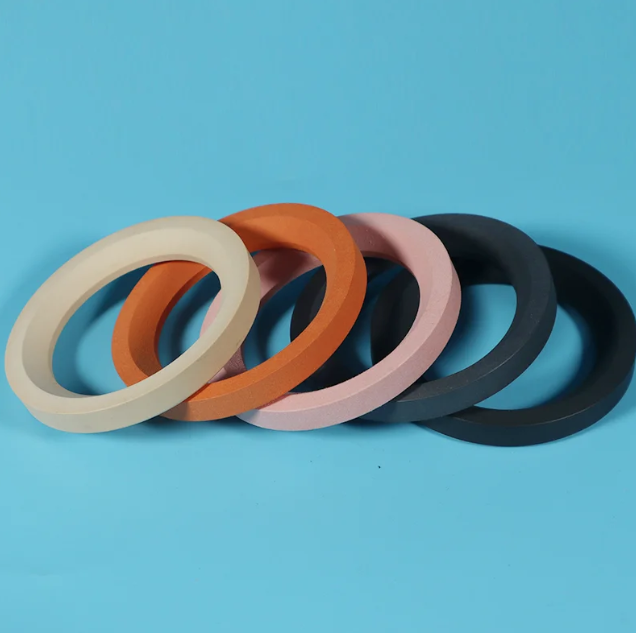
Leak paths are rarely the result of a single bad dimension. They tend to emerge from smaller, individually acceptable deviations that line up in an unfavorable way. A flange face that is a few microns low, a counterbore slightly deeper than nominal, and a bolt hole offset just enough to reduce the sealing land can each pass inspection on their own, yet together they form a continuous channel. That is the practical face of tolerance stack-up: not an obvious defect, but a quiet accumulation of allowable variation that leaves a gap where none was intended.
The stacks that matter most often involve form and position rather than size alone. Two mating surfaces can meet their flatness requirements and still create a wedge-shaped clearance when assembled because their high and low points settle into the worst possible alignment. Add a small perpendicularity error on a sealing shoulder or a slight mismatch in bolt circle positions, and the compressive force across the face becomes uneven. The result may be a joint that holds at low pressure and opens only when the housing flexes, producing a leak that is intermittent and difficult to trace back to any one feature on the drawing.
Controlling these conditions is less about tightening every tolerance and more about understanding which dimensions define the narrowest point in the leak path. A worst-case or statistical analysis can show that only one or two contributors actually control the minimum clearance. Once those are identified, it is often cheaper and more effective to hold them tightly while leaving the rest of the part at broader, more producible tolerances. In many assemblies, closing the leak path is not a matter of making the entire drawing tighter, but of recognizing where the stack-up actually decides whether a gap appears.
Creep, Cold Flow, and the Real Life of a Pressed Seat
A seat cushion rarely fails by snapping or tearing. Instead, it slowly gives up its shape. The polyurethane foam inside a pressed seat loses thickness over months and years, and the change is often blamed on poor quality. Most of the time, though, what is happening is a combination of creep and cold flow. Under a steady load, the polymer chains in the foam rearrange themselves. The air that once helped the foam spring back is gradually squeezed out of the cell walls, so the material takes on a new, flatter set rather than returning to its original height.
Cold flow adds another layer. It is not about temperature, despite the name. The foam slowly moves away from concentrated pressure, shifting from the areas directly under the hips and thighs toward the edges of the cushion. That is why an old seat often feels thin in the center while the bolsters seem fuller than they were when new. The material has not disappeared; it has migrated. Over time, the surface can also develop a slight skin-like stiffness where the cells have collapsed and consolidated.
None of this happens overnight. The early weeks of use mostly show a reversible softening, but the longer-term set is what changes how a seat actually supports the body. Once the foam has crept and flowed into a new profile, adding more cushioning on top may only mask the problem. The real life of a pressed seat is written into the way the material responds to load, and that response never stops evolving.
Thermal Cycling Stability Beyond the Spec Sheet
The numbers on a datasheet usually stop at a fixed cycle count, but real assemblies see temperature swings that never follow a clean square wave. Ramp rates, dwell times, and the direction of heat flow all shift how stress concentrates at interfaces. What looks like a stable material on paper can start accumulating damage in places that a single pass/fail threshold never reveals.
A more useful view comes from watching how resistance, mechanical integrity, or leakage current drifts across hundreds of shallow cycles rather than a handful of extreme ones. Early microcracking tends to form near CTE mismatches, and that damage often stays electrically invisible for a long time before it becomes a hard failure. Tracking that quiet degradation window gives a much clearer picture of what the part will do in a product that runs for years.
That is why cycling stability should be judged by the shape of the degradation curve, not only by the final survival count. If a component holds its key parameters within a tight band through the middle of its life, it tends to tolerate field conditions far better than a part that barely passes an accelerated test.
Surface Finish and Sealing Contact That Keeps Media Where It Belongs
A smooth flange face can still leak if the finish was produced the wrong way. What matters is not just the Ra value but the direction and continuity of the machining marks. Spiraling grooves can act as capillary paths, giving pressurized fluid a slow route past the gasket. A controlled, concentric finish interrupts that route often enough to keep the media from creeping outward.
Sealing contact depends on the gasket conforming to the metal surface under load. If the surface is too coarse, the gasket bridges across the peaks and leaves narrow gaps that open once temperature cycles begin. If it is too polished, the gasket may skate slightly during assembly, shifting the contact patch. The practical sweet spot usually sits in a finish band where the material can embed without losing rebound.
Bolt preload plays an equal part here. Even a well-finished face and a high-grade gasket will not hold if the fasteners relax over the first few hundred hours. The goal is a stable contact stress field across the sealing ring, with no local drop-off near bolt holes or pipe loads. When that field stays consistent, the fluid stays inside, not around the joint.
Supplier Process Control and Traceability Signals Worth Asking About
Ask a supplier how they trace a single lot of raw material through to finished goods, and you will quickly see whether their system is built on confidence or guesswork. Strong partners can walk you through the exact hand-off points, the equipment used at each stage, and the people who signed off on critical measurements. Weak ones tend to offer vague assurances about “quality checks” without being able to show where those checks actually happened or what happened when something drifted out of range.
The real tell is how a supplier handles near-misses. If a batch barely passed its final inspection, does anyone dig into why it was close to the edge? Do operators on the floor have the authority to pause a line, or is stopping production treated as a career risk? Culture shows up in those small decisions. A supplier that quietly records and investigates borderline results is one that understands process control as a living practice, not a checkbox for an auditor.
Traceability also means being able to move backward fast when a problem appears downstream. Ask for a mock recall scenario: give them a fake batch number and see how long it takes to identify affected shipments, raw material lots, and in-process hold points. The answer you want is measured in minutes or hours, not days. If the response starts with “we would need to check with the warehouse team,” that delay itself is a signal worth weighing against whatever savings their quote promises.
FAQ
The main difference shows up in material traceability and process control. A dependable supplier will know the resin source, lot history, and whether the PTFE is virgin or reprocessed. They usually control sintering cycles rather than buying generic rod and cutting it. When something goes wrong in the field, they can trace the failure back to a specific batch. Generic machine shops rarely have that depth.
Virgin PTFE is the safe default, but the right grade really depends on the service. For aggressive chemicals or high-temperature cycling, a modified PTFE with reduced creep and better dimensional stability often outperforms standard granular PTFE. Fillers like glass or carbon can help with wear resistance, but they may sacrifice some chemical inertness. A good supplier will ask about the media, pressure, and temperature before suggesting a grade rather than quoting a one-size-fits-all material.
Ask for capability data on specific features, not just a general tolerance chart. A supplier that regularly produces seat lips, bevels, and sealing faces should be able to show Cpk values or at least recent inspection reports for similar parts. It also helps to request a first-article layout with the actual measured dimensions. If they hesitate to share that, the risk of stacking small deviations into a leak path increases significantly.
Creep is the biggest enemy. A well-designed seat accounts for cold flow by using controlled compression, proper lip geometry, and enough cross-section to resist deformation. Sharp corners should be avoided because they create stress points. The best suppliers often suggest small geometry changes, like a radius here or a changed angle there, that make the difference between a seat that seals for years and one that relaxes after a few hundred cycles.
Beyond dimensional inspection, look for leak-related testing such as pressure decay, helium leak detection, or functional cycling on a fixture. For critical applications, thermal cycling tests help reveal whether the seat will recover after temperature swings. A supplier that only checks dimensions is not really proving seal performance. The exact test plan should match the valve service conditions rather than being a generic batch checklist.
Usually yes, because it shortens the feedback loop when a material or process issue appears. In-house molding allows the supplier to adjust sintering profiles and press parameters for the specific geometry. That control often leads to lower porosity and more consistent crystallinity, both of which matter for leak-free performance. Outsourced molding can still work, but it requires much tighter supplier quality oversight.
The cheapest seat is rarely the least expensive over the valve's life. Downtime, product loss, and field replacements quickly erase upfront savings. That said, a higher price does not automatically mean better performance. The smarter approach is to compare suppliers on the full cost of ownership: verified material lot consistency, documented process controls, and test data that match your actual operating conditions. Paying for those controls is usually worth it, while paying for marketing claims is not.
Conclusion
Most of what decides whether a PTFE valve seat holds a seal is settled long before final inspection. The resin grade and filler package reveal more than a generic “PTFE” label, since recycled or poorly selected material tends to relax and deform in ways that virgin resin does not. From there, dimensional control takes over. A few thousandths of variation across the seat OD, lip height, or retaining groove can turn an otherwise good seat into a leak path once the valve is assembled and cycled. Pressed and sintered seats also have a long-term behavior that no datasheet fully captures: creep and cold flow gradually reduce sealing force, so the supplier should be able to explain how geometry, resin choice, and preloading are balanced against that relaxation. Thermal cycling is another reality. A seat that looks stable at ambient conditions may lose lip compression after repeated swings between low and high temperatures, which means asking about tested thermal cycles is more useful than accepting a single temperature rating at face value.
The sealing interface itself is where surface finish and flatness become non-negotiable. Even a chemically pure, dimensionally accurate seat will leak if the contact face is too rough, out of flat, or loaded unevenly around the lip. That is why suppliers who control the final lapping or machining step rather than relying on a visual check tend to produce more repeatable results. Behind all of this sits process control and traceability. It is reasonable to ask whether the supplier batches raw resin, inspects dimensions after sintering or thermal conditioning instead of only in the green state, and keeps lot-level records that connect a finished seat back to its material certification. Those practices are not marketing extras; they are what catch a slow drift in firing temperature or a supplier-side resin substitution before it becomes a field failure. If a manufacturer can answer those questions with specific measurements and date-coded records, the seat is far more likely to stay leak-free when it actually matters.
Contact Us
Contact Person: Tommy Xiao
Email: [email protected]
Tel/WhatsApp: 8615651509888
Website: https://www.ptfe-factory.com