

Power Line Inspection Drone Simulator Ranking: Top Virtual Training Platforms Compared
2026-09-04
Ask any drone pilot who’s trained for power line inspection, and they’ll tell you the same thing: real-world practice is risky, expensive, and painfully slow to arrange. That’s why simulator-based training has become the go-to prep method for utilities and independent pilots alike. In this ranking, we compare the top virtual training platforms on the market today—focusing on physics accuracy, inspection workflow fidelity, and how well each one handles the unique hazards of energized lines. Among the standouts, SRIZFLY has been making waves for its detailed line-tracking scenarios and responsive flight dynamics. If you’re weighing your options, read on to see which simulators actually prepare you for the field instead of just looking good in a demo.
Why Flight Simulators Are Becoming Standard for Line Inspection Crews
Line inspection work demands split-second judgment in conditions that shift without warning—low clouds rolling over a ridge, wind shear near a tower, or a sudden loss of visual reference. Traditional training relied heavily on on-the-job hours, but real aircraft put both crew and equipment at risk while teaching those hard lessons. Flight simulators remove that physical danger while preserving the intensity. A pilot can rehearse a wire strike scenario a dozen times in one afternoon, feeling the aircraft shudder and learning the muscle memory needed to react, without ever leaving the ground.
Beyond safety, simulators offer a controlled space to practice the rare and the routine with equal precision. Inspection flights often follow predictable routes, but the moments that matter are the exceptions—an engine hiccup at low altitude, a bird strike, or a misjudged turn around a structure. In a simulator, instructors can inject these events at random, forcing crews to stay alert rather than coast through familiar territory. Over time, that builds a kind of quiet confidence that doesn't come from reading manuals or watching videos.
Cost also plays a growing role. Fuel, maintenance, and aircraft downtime eat into inspection budgets, while simulator hours cost a fraction of real flight time. As the technology improves—better visuals, more accurate flight models, and even virtual reality integration—the gap between simulator and actual aircraft narrows. For line inspection crews who need to log proficiency without burning expensive hours, the simulator has shifted from a luxury to a practical necessity.
What a Power Line Simulator Should Feel Like From the Pilot Seat
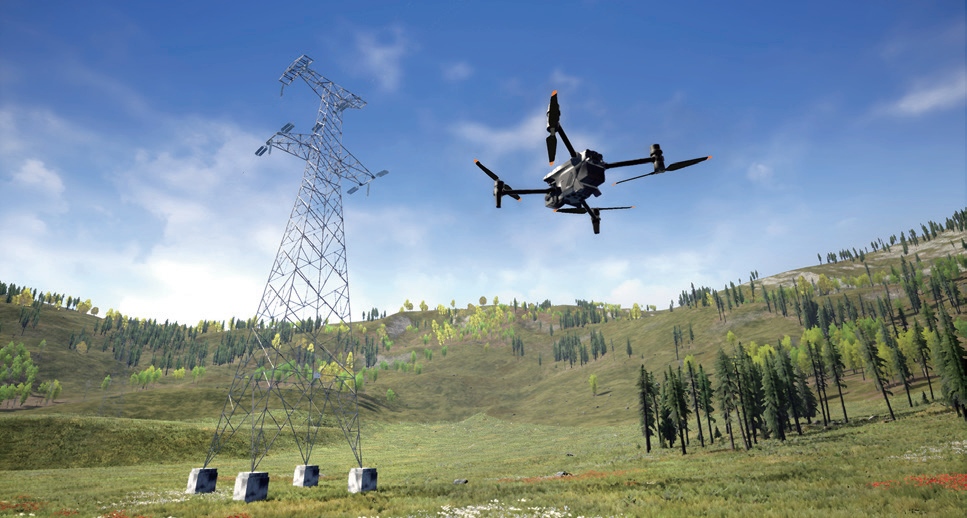
Sitting in the pilot seat of a power line simulator should not feel like a video game. The first thing you notice is the slight vibration through the collective and cyclic—subtle, irregular, tied to rotor RPM and wind gusts rather than a canned rumble. When you ease the helicopter closer to a conductor, the control response tightens just enough to make you readjust your grip, as if the air itself has become denser near the wires.
The visual scene needs to trick your peripheral vision. Power lines should sag under their own weight and sway slightly in crosswinds, with specular glints that shift as your viewing angle changes. In your headset, the turbine whine and rotor chop should shift realistically with power changes, and you might hear the faint crackle of electrical field when hovering too close—not a loud alarm, but a subtle cue that makes the hair on your arms stand up.
When a simulated emergency hits—say a sudden gust pushes you toward a tower or the wire tension changes after a fault—the simulator should make your pulse climb. The controls should feel heavier, the outside references blur with vibration, and your decision time shortens because the scenario unfolds with messy, real-world unpredictability. That’s the difference between a training tool and a desktop toy: you step out of the seat with sweaty palms and a deeper respect for the line.
The Features That Actually Matter When Training for Tower and Wire Work
Most training programs waste time on classroom theory that falls apart the moment you're thirty feet up with wind pulling at your harness. What actually sticks is repetitive, supervised practice with the exact gear you'll use on the job—double-legged lanyards, positioning straps, rope grabs, and the specific connectors your crew trusts. If the course doesn't force you to climb, transition, and hook in until it becomes muscle memory, it's not preparing you for the real thing.
Just as important is learning how to read the structure and the weather together. Tower work rarely happens in calm, clean conditions, so good training puts you on wet steel, worn rungs, or a slightly leaning monopole and asks you to problem-solve your route. You need to practice controlled descents and emergency pick-offs with a partner, not just watch a video about them. The features that matter are the ones you can feel in your hands and your balance—anything less is just an orientation, not training.
How the Leading Platforms Handle Wind, Sag, and Magnetic Interference
When wind gusts hit a high-voltage corridor, the top inspection platforms do not simply fight the turbulence with brute motor power. They combine real-time wind speed readings from onboard anemometers with rapid attitude adjustments driven by fused IMU and visual odometry data. This allows the system to lean into gusts, maintain a stable offset from the conductor, and avoid sudden lateral drift that would blur camera or LiDAR captures.
Conductor sag is handled as a moving geometry problem rather than a fixed flight altitude. Leading platforms build a live 3D profile of the line using LiDAR or stereo vision, then adjust their inspection distance as the wire dips under thermal load or ice. At the same time, magnetic interference from high current is not corrected by simply shielding the compass. Instead, these platforms switch to dual-antenna GNSS heading or tightly coupled visual-inertial odometry, which keeps the yaw reference stable even when electromagnetic fields would otherwise send a magnetometer spinning.
A No-Nonsense Look at What Each Simulator Does Differently
Most simulators claim to be accurate, but the real differences show up in how they handle edge cases like low-speed collisions or uneven tire wear. One might prioritize suspension geometry down to the millimeter, while another focuses on engine mapping that reacts to altitude changes. These aren't just feature list items—they change how a lap time breaks down.
Take a rainy session as a test. One simulator might simulate aquaplaning based on real-time water depth per tire patch, while another approximates it with a global grip multiplier. The first feels twitchy and demanding, the second more forgiving but less informative. Neither is wrong, but you'll learn different lessons about car control.
The takeaway is simple: look past the marketing and check the change logs or community telemetry. What a simulator chooses to model in detail tells you exactly what kind of driver it wants you to become.
Choosing a Platform That Matches Your Team’s Real Inspection Routes
Most inspection platforms look great in a demo but fall apart the moment your team deviates from the pre-planned route. If a crew has to skip a locked gate, follow a washout detour, or split up to cover both sides of a rail line, the software should handle that without requiring a dispatcher to rebuild the schedule. Ask vendors how their system treats unplanned stops, ad hoc check-ins, and route changes that happen in the field — not just how it displays a clean map.
The real test is whether the platform mirrors the way your inspectors already work. Some teams run linear routes along pipelines or transmission corridors; others work in clustered zones where the order changes daily based on weather or access permits. A tool built around fixed sequences will force your crew into awkward workarounds. Instead, look for options that let you define route logic — nearest-neighbor, priority-based, or manual drag-and-drop — and then compare that against a week of actual GPS tracks from your best inspectors.
Also watch offline behavior and data sync. Real inspection routes often lose cellular coverage exactly where the work gets difficult. A platform that queues photos, forms, and timestamps locally, then syncs when signal returns, is far more valuable than one with a fancy dashboard that only works in the office. Bring a field supervisor into the evaluation and have them run a route that includes a dead zone, a last-minute reassignment, and a partial completion. If the software handles those smoothly, it’s likely to survive your real-world routes.
FAQ
The top spot usually goes to a platform that combines realistic terrain modeling with electromagnetic field visualization. For most utility companies, that means a customized build on AirSim or a commercial option like DJI's enterprise simulator, because they let you recreate sag, clearance violations, and camera gimbal behavior under wind load.
Generic sims focus on stick time and basic maneuvers. A power line inspection sim adds things like wire proximity warnings, tower climbing views, thermal camera feeds, and fault injection for broken insulators. You're not just flying - you're learning to spot corrosion or vegetation encroachment while maintaining safe standoff distance.
They can be, if you have the in-house skills to build the environment. AirSim and Gazebo let you import point clouds of real transmission corridors, but you'll spend dozens of hours tweaking physics and camera models. Commercial platforms often include pre-built corridors, so the trade-off is time versus license cost.
A dedicated GPU with at least 8GB VRAM is the baseline for smooth thermal rendering. A controller with hall-effect sticks helps with fine gimbal adjustments, and if you're practicing with a spotter, dual monitors or a VR headset make a big difference. Don't overlook a stable desk mount for the radio - hand fatigue ruins precision work.
The better ones let you set wind gusts, rain, fog, and sun angle. For instance, you can practice a dawn patrol where the sun hits the conductors at a low angle and washes out your camera feed. Some platforms even model ice loading on wires, which changes sag and makes the inspection path trickier.
Never fully, but it should cover 60-70% of the initial stick time. Emergency procedures like motor failure over a right-of-way or sudden yaw drift are much safer to drill in a sim. The field is still needed for regulatory compliance, crew coordination, and the physical feel of wind on your face.
They prioritize scenery graphics over scenario depth. A photorealistic tower is useless if the software doesn't model conductor proximity alarms or let you replay a flight with telemetry overlaid on the map. Ask vendors for a trial flight along a sagging span before committing.
Look for one that logs stick inputs, battery sag, gimbal angles, and distance to nearest conductor at 10Hz or better. UGCS and some custom AirSim builds excel here because you can scrub through a mission and see exactly where you busted clearance limits - or lost visual line of sight.
Conclusion
Line inspection crews have moved past the idea that simulators are just video games. The reason is straightforward: real-world mistakes near energized conductors and steel lattice towers carry consequences no training budget can absorb. A good power line inspection drone simulator has to reproduce the feel of standing in the field with the controller in your hands—slight stick delays, camera gimbal drift, the way a drone pitches when a crosswind catches it between two conductor bundles. The best platforms treat wind as an active force, not a cosmetic setting. They let you feel the line sag on hot days, the tug of magnetic interference when you get too close to high-voltage hardware, and the way rotor wash changes near tower arms. That level of detail is what separates a meaningful training tool from a pretty 3D map.
When you line up the leading platforms side by side, their differences become obvious quickly. Some spend their development effort on flight dynamics and hardware-in-the-loop compatibility, so your actual transmitter works. Others win on route realism—letting you import surveyed corridors, adjust tower spacing, and practice the exact inspection path your team flies every Tuesday. A few stand out for post-flight review, with frame-by-frame replay and automated defect tagging that mirror how field data is actually used. The honest take is that no single simulator dominates every category. The right choice is the one that mirrors your utility's terrain, voltage classes, and inspection checklist without forcing your crew to adapt to someone else's idea of a typical line. Rank the platforms by how little you have to explain to a new pilot when they step outside for the real flight.
Contact Us
Contact Person: Niles Liu
Email: [email protected]
Tel/WhatsApp: 8619945009803
Website: https://srizfly.com/