

Laser Safety Curtain Manufacturer: High-Quality Solutions for Industrial Safety
2026-11-16
A laser beam doesn't give second chances. In busy industrial environments, one unguarded reflection is all it takes to put operators at risk—and shut down your line. That's why choosing a laser safety curtain manufacturer isn't a box-ticking exercise. LASERPAIR designs high-quality solutions that make industrial safety a natural part of your workflow, not a compliance afterthought. Here's what actually separates a curtain that protects from one that merely covers.
Not All Laser Curtains Survive a Direct Hit — Here's What Changes
Laser curtains are engineered primarily as detection barriers, not armor. When a projectile or high-energy blast lands squarely on one, the outcome depends heavily on how the system was built. Cheaper units often use a single-layer polymer sheet that shatters or burns through almost instantly, leaving a hole that cannot be compensated for by the photoelectric sensors. The real weakness isn’t just the material — it’s the lack of redundancy in both power routing and structural support. Once a critical node fails, the entire curtain goes dark.
What separates a survivable laser curtain from a disposable one comes down to a handful of design shifts. Some manufacturers now embed sacrificial ablative layers that peel away under heat, preserving the inner emitter matrix long enough for a partial shutdown. Others route power through multiple isolated channels, so a direct hit on one side doesn’t kill the whole grid. There’s also a move toward flexible, self-healing polymer skins that can reseal small punctures before contaminants reach the optics. Still, even with these upgrades, a direct hit from a heavy slug or shaped charge will likely require a full module replacement — the goal is simply to keep the rest of the perimeter active for a few extra seconds.
Why Your Current Safety Setup Might Be Slowing Down Production
Many plants treat safety as a series of hard stops—guards that trigger a full line shutdown the moment a light curtain is broken, or lockout procedures that demand a fifteen-minute walkthrough before a simple jam can be cleared. On paper, that sounds rigorous. On the floor, it often means every minor interruption turns into a production standstill. The result is that operators start finding workarounds: taping a sensor, propping a gate open, or skipping a verification step just to keep the line moving. The slowdown isn't from the safety device itself—it's from a setup that was never tuned to the pace of the actual tasks.
A better approach doesn't trade protection for speed. It rethinks where and when to apply stopping power. For instance, zone-based muting allows a robot to slow down rather than freeze when a worker enters the outer perimeter, while still tripping a full stop in the inner critical zone. Similarly, integrating safety logic with the machine controller can distinguish between a deliberate setup change and an accidental intrusion, cutting unnecessary halts by more than half. The goal isn't fewer safety checks—it's smarter ones that match the real risk level of each moment.
The fastest fix is often a review of your current safety response hierarchy. List every safety-triggered stop from the past month, then ask: did this stop prevent an injury, or did it just penalize normal operation? Many teams are surprised to find that two-thirds of their slowdowns come from overbroad sensor ranges, outdated interlock logic, or e-stop buttons placed where elbows bump them. Adjusting these parameters—not removing them—can recover significant throughput without touching the actual risk reduction. When safety adapts to the process instead of fighting it, production stops losing time to false alarms and starts gaining that time back in real output.
Wavelength-Specific Fabrics: The Overlooked Variable in Laser Safety
Most laser safety discussions fixate on eyewear, enclosures, and administrative controls, yet the fabric covering a worker’s body rarely enters the conversation. This blind spot is puzzling because textiles respond to laser radiation in profoundly wavelength-dependent ways. A cotton lab coat that diffuses a 532 nm green beam might absorb strongly at 1064 nm, converting that energy into heat and charring within milliseconds. Polyester blends melt and adhere to skin under certain infrared wavelengths, while natural fibers like wool tend to carbonize rather than drip. These behaviors are not intuitive; they hinge on molecular bond resonances, dye chemistry, and weave density.
The practical consequence is that ordinary protective clothing can give a false sense of security—or actively worsen an injury. At ultraviolet wavelengths, many synthetic fabrics degrade and lose tensile strength after repeated exposure, yet still look intact. In the near-infrared, dark-colored cotton can ignite at irradiance levels well below those that cause immediate eye damage, turning a near miss into a burn incident. Even more troubling, some flame-retardant treatments applied to fabrics are optimized for thermal hazards like flash fires, not for the nanosecond-scale energy deposition of a Q-switched laser. Testing standards for laser protective clothing exist, but they are rarely invoked outside specialized research or military contexts. Facility safety officers should treat garment selection as part of the hazard analysis—not an afterthought.
The Difference Between a Curtain That Blocks Light and One That Contains Damage
Many people assume that a curtain's ability to block light automatically means it can also contain damage, but these two functions rely on entirely different material properties. Light-blocking curtains are typically made from dense weaves or coated fabrics that stop photons from passing through. Damage containment, on the other hand, requires structural integrity under stress—think tear resistance, tensile strength, and the ability to prevent small rips from spreading. A blackout curtain might be excellent at creating a dark room, yet it could easily shred if snagged by a sharp object or pulled too hard.
The confusion often stems from marketing language that lumps “heavy-duty” and “light-blocking” together. In reality, a curtain designed to contain damage—say, in an industrial setting or a high-traffic hallway—must be engineered with reinforced stitching, ripstop weaves, or even layered composites. These features add weight and cost, but they don't automatically improve light blockage. Conversely, adding a light-blocking foam backing to a thin fabric might darken a room, but it does nothing to stop a tear from running across the panel.
Choosing the right curtain means first identifying what you're actually trying to prevent: light leakage or physical failure. If you need both, look for materials that combine a tightly woven face with a resilient core, and check for independent test data on tear propagation—not just opacity ratings. Otherwise, you might end up with a curtain that keeps the sun out but falls apart the moment someone yanks it too hard, or one that withstands abuse yet lets every ray of light sneak through.
Modular Safety Systems for Spaces That Change Layouts Often
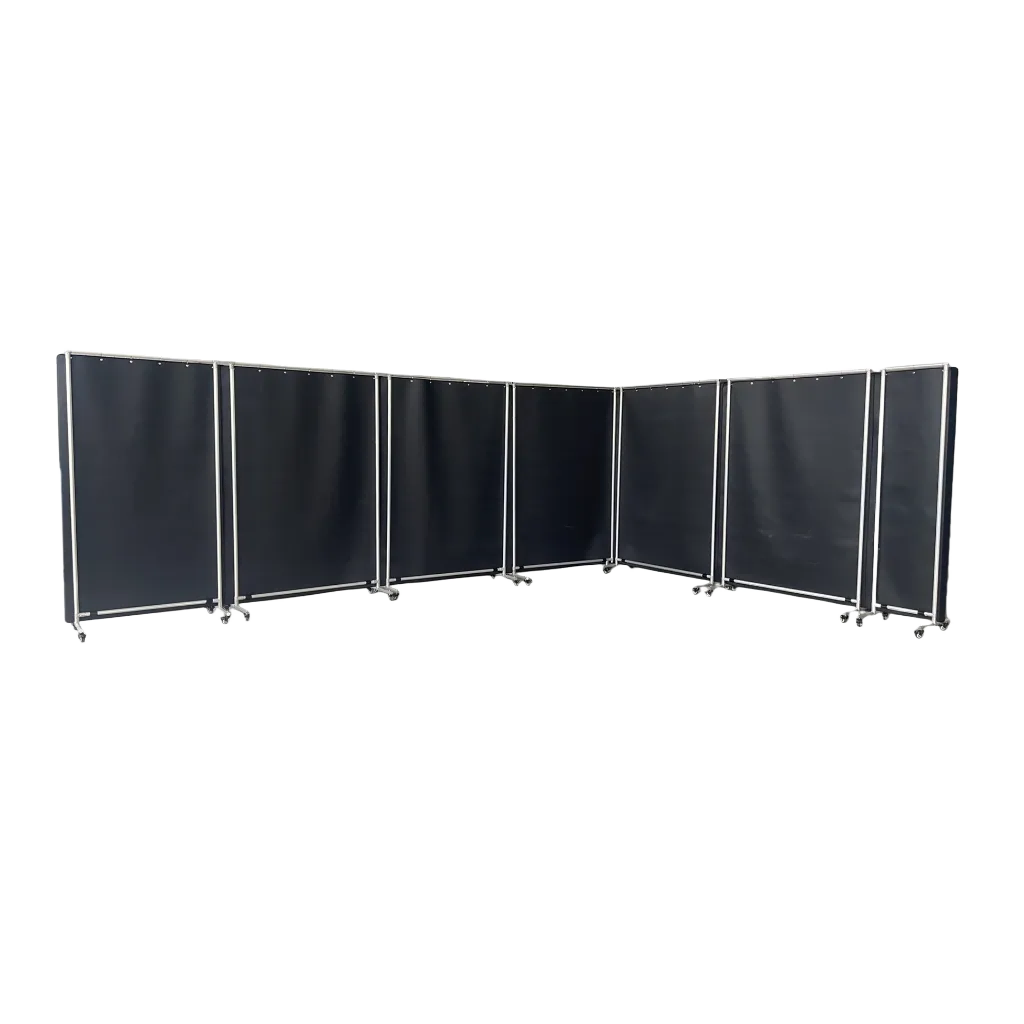
Fixed guarding and hardwired interlocks make sense for a production line that rarely moves, but they quickly become a liability when workcells are rearranged every few weeks. Modular safety systems address this by treating each safeguard as a movable component: lightweight fencing panels, plug-and-play light curtains, and magnetic interlock switches that can be repositioned without cutting conduit or pulling new cable. Instead of shutting down for days to revalidate a layout, teams simply unplug a module, move it to the new zone, and reconnect it through a standard interface.
The real advantage shows up in shared spaces like pilot plants, training labs, and event staging areas where the same floor space may host completely different operations from one month to the next. Here, modular safety components are often mounted on wheeled frames or quick-release brackets, so a robot cell can be enclosed one day and opened up for manual assembly the next. Wireless emergency stop buttons and coded safety controllers let you reconfigure the safety logic through software rather than rewiring a panel, which means fewer errors and less temptation to bypass a guard that no longer fits.
Long-term, this approach doesn't just save time; it keeps safety performance consistent. When moving a fixed guard requires special tools and a maintenance ticket, people tend to leave it off or force it into place. A modular system designed for frequent changes lowers that friction, so the correct guard is more likely to be in position every time. It also simplifies compliance, because each module carries its own rating and can be added or removed without triggering a full system teardown.
How We Help Facilities Pass Audits Without Last-Minute Scrambling
Most facilities only think about audits when the notification arrives. By then, it's too late to fix missing documentation or training gaps without pulling staff off their regular duties. We take a different route: we embed audit readiness into daily operations, so your team never has to switch into panic mode.
Our approach starts with a detailed gap analysis against the specific standards your next audit will use—whether that's Joint Commission, CARF, or a local regulatory body. We then break down every requirement into small, routine tasks assigned to the right people. Checklists live where your staff already work, not in a binder that gets opened once a year.
What really removes the last-minute scramble is our monthly readiness review. We pull samples of records, observe a few processes, and compare them to audit criteria. If something drifts, we fix it that week, not the week before the surveyor walks in. By the time the actual audit happens, your team has been practicing the right habits for months, so the visit feels like just another day.
FAQ
Look beyond basic certification. A dependable supplier will walk you through optical density mapping, beam alignment tolerances, and how the curtain material behaves after prolonged UV exposure. Ask for real test reports, not just spec sheets.
Welding curtains are not built for coherent laser light. Quality laser curtains use multi-layer composites tuned to specific wavelengths and power levels, and they maintain their protective properties even if the surface is scratched or flexed repeatedly.
Usually yes. Industrial laser workcells rarely match off-the-shelf dimensions. A manufacturer that can supply framed panels, roll-up versions, or linked strips with proper overlap will reduce stray reflections far better than a one-size-fits-all blanket.
Ask for EN 60825-4 or ANSI Z136 compliance evidence, plus independent lab test data. Reputable manufacturers can provide documentation for specific wavelength ranges, not just a generic laser-safe label.
A curtain might look dense but still transmit dangerous levels of invisible infrared. Optical density tells you exactly how much attenuation occurs at your laser's wavelength. A good manufacturer will help calculate the required OD for your setup.
Schedule periodic inspections with a power meter and check for burns, delamination, or mounting gaps. Some manufacturers offer re-certification or replacement programs after a certain number of exposure hours.
Clarify how the curtain interfaces with machine guards and emergency stops. A well-designed system includes proper bracketry, floor seals, and interlock-compatible frames so that bypassing is difficult and the safety circuit remains intact.
Yes. For kilowatt-class or femtosecond systems, look for vendors that offer glass-fiber composites or multi-layer polycarbonate blends. These handle thermal load and peak power better than standard PVC or vinyl curtains.
Conclusion
Most laser safety curtains on the market are built to block light, not to take a beating. A direct hit from a high-power beam—especially from a fiber or diode laser—can melt through the surface, leaving a hole that quietly turns into a hazard. That's the gap we address at the manufacturing level. Our curtains use wavelength-specific fabrics that don't just attenuate the beam; they're engineered to contain damage, preventing a small burn from spreading into a tear or a gap. This matters because standard polycarbonate or PVC panels often fail differently at 1064 nm than at 10.6 µm, and choosing the wrong material can give you a false sense of security. We test for both optical density and physical resilience under sustained exposure, so the curtain you install actually matches the laser you use—not just the wattage on a spec sheet.
Beyond protection, your safety setup shouldn't force you to pause a line every time you need to adjust a fixture or move a station. Rigid enclosures and fixed barriers slow down production, especially in job shops or research labs where layouts shift monthly. Our modular safety systems use interlocking panels and quick-release frames, so you can reconfigure an area in an afternoon instead of waiting for a custom build. And when audit season rolls around, you won't be scrambling for documentation or patching gaps at the last minute. We provide clear labeling, material certifications, and layout schematics as part of the package, which helps facilities walk through a laser safety audit without the usual fire drill. The goal is straightforward: a curtain that survives real use, fits a changing floor plan, and keeps your operation running instead of holding it back.
Contact Us
Contact Person: Jenny
Email: [email protected]
Tel/WhatsApp: +86 13537713281
Website: https://www.laserpair-safety.com/