

EMI Filter Brands Compared: Which Offers the Best Noise Suppression?
2026-10-15
Shielding your electronics from electromagnetic interference isn’t just about picking any filter off the shelf—it’s about finding the one that actually silences the noise. But with so many brands claiming top-tier suppression, how do you separate real performance from marketing hype? In this comparison, we put popular EMI filter brands to the test, and one name keeps surfacing: DOREXS. Let’s dig into the data before you commit your design to the wrong component.
The Real Meaning of Insertion Loss and Attenuation Curves
Insertion loss often gets reduced to a single number on a spec sheet, but that number hides a story about how a component interacts with the system around it. When you measure insertion loss across frequency, you're not just seeing how much signal disappears; you're seeing the cumulative effect of impedance mismatches, material absorption, and even small reflections that happen inside connectors or splices. The curve itself is a fingerprint of the device, and its shape tells you whether the loss is dominated by a clean, broadband effect or by resonant dips that point to specific structural issues.
Attenuation curves, on the other hand, map how a transmission medium weakens a signal over distance or frequency. For optical fiber, the curve bends upward at shorter wavelengths because of Rayleigh scattering and at longer wavelengths due to infrared absorption, leaving a low-loss window in between. For copper or coaxial cable, the curve climbs steadily with frequency as skin effect and dielectric losses take over. Reading these curves correctly means recognizing that "attenuation" is not a fixed property but a condition-dependent behavior, and that seemingly small changes in slope can imply very different system margins.
What often gets lost is that both insertion loss and attenuation curves are comparative tools, not absolute verdicts. A sharp dip at a particular frequency might be harmless if your signal never goes there, or catastrophic if it sits right in your channel. The real meaning emerges when you line up the measured curve against your actual operating range and ask where the energy is going, not just how much is gone.
How Filter Topology Impacts Noise Suppression Depth
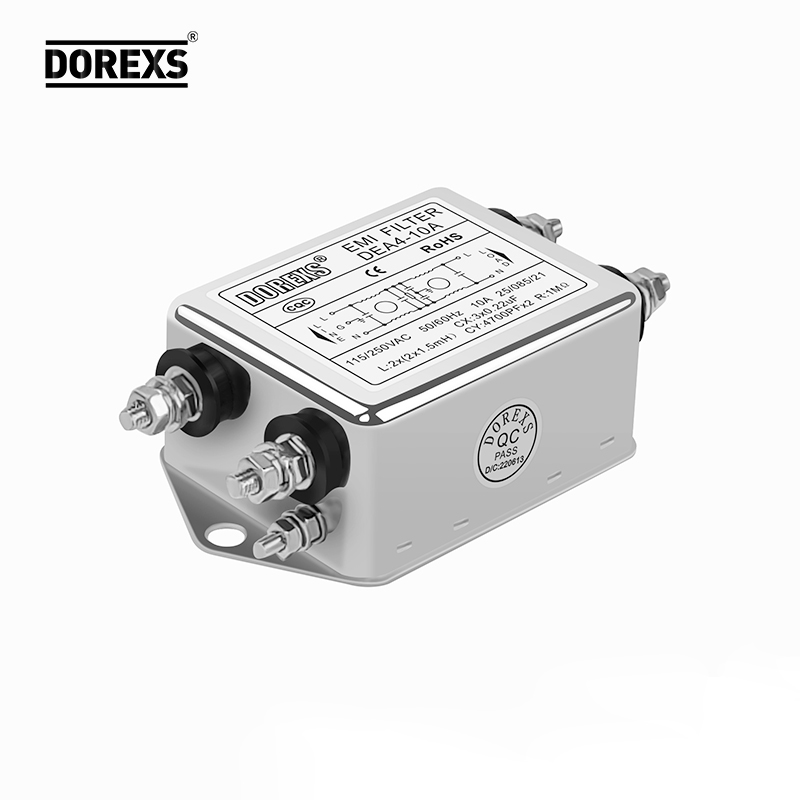
The way a filter is arranged sets where its zeros and poles fall, and that directly determines how deep the stopband attenuation goes. A basic single-pole RC low-pass only rolls off at 20 dB per decade, so noise just above the cutoff still leaks through at meaningful levels. Moving to a multi-stage or feedback-based topology, such as Sallen-Key or multiple feedback, places additional poles in the stopband and steepens the roll-off, which translates into noticeably deeper suppression for the same frequency offset.
Topology also shapes how component tolerances and parasitic effects eat into the theoretical attenuation. Some active filters promise a sharp roll-off but become twitchy when capacitor values drift or when the op-amp runs out of open-loop gain, causing stopband peaking or shifted zeros that reduce the expected depth. Passive ladder structures tend to behave better in this regard, since the signal energy is attenuated stage by stage and no single component deviation collapses the entire stopband shape.
Differential or balanced topologies add another mechanism for depth by canceling common-mode noise at the output, without relying solely on a steeper roll-off. The catch is that path matching has to be tight; any imbalance leaves a residual noise component that caps the achievable suppression. So the practical depth comes from a mix of pole placement, sensitivity to real-world parts, and how well the topology rejects noise that appears equally on both lines.
Component Selection: The Difference Between Spec and Reality
Most engineers start a design with a shortlist of parts whose datasheet parameters tick every box. The printed numbers for tolerance, ESR, saturation current, or noise density look reassuringly precise. But those figures are typically captured under narrow laboratory conditions: a specific temperature, a defined test frequency, a fresh sample, and often a carefully chosen bias point. Once that same part sits on a real board surrounded by heat, switching noise, and years of drift, the actual behavior can wander surprisingly far from the headline spec.
Take a ceramic capacitor as an example. The datasheet may promise 10µF with X7R dielectric, but apply a 12V DC bias and that capacitance might drop by half or more depending on case size and voltage rating. Similarly, an inductor rated for 2A saturation current might lose 30% of its inductance well before that threshold if you overlook the fine-print definition of saturation as a specific percentage drop. These are not defective parts; they are simply operating outside the narrow slice of reality where the datasheet was measured.
Practical component selection therefore means testing the parts you will actually use, on the board you will actually ship, under conditions that resemble the field. Build margin for lot-to-lot variation, temperature extremes, and aging. Derate based on measured curves rather than nominal values, and keep a bench reference of “known good” and “known marginal” components. The difference between spec and reality is not a flaw in the datasheet—it is a gap that a good engineer learns to anticipate and close with hands-on verification.
Installation Factors That Can Make or Break a Filter
A filter's performance often hinges on details that are easy to overlook during installation. The sealing surface is a common failure point: if the old gasket isn't fully removed or the new one gets pinched, unfiltered fluid can bypass the media entirely. Even a slight misalignment of the housing can create a leak path that only becomes obvious under pressure.
Torque matters more than most people think. Over-tightening a canister or spin-on filter can warp the base plate, crack the housing, or compress the gasket unevenly, leading to slow drips or sudden blowouts. Using a torque wrench and following the manufacturer's specified range prevents these issues, but many installers rely on feel, which varies from person to person.
Direction and pre-filling are also critical. Installing a filter backward or forgetting to lubricate the O-ring with clean fluid can cause immediate damage or difficult removal later. Pre-filling cartridge-style filters before startup reduces dry running and extends element life, yet this step is often skipped in rushed maintenance routines. Small choices during installation determine whether the filter protects the system or becomes the weak link.
Application-Specific Performance Across Industrial, Medical, and Automotive
The demands placed on electronic components shift dramatically depending on the environment they operate in. In industrial settings, equipment often runs around the clock, exposed to voltage spikes, electromagnetic interference, and wide temperature swings. Components here are selected not just for their nominal specifications but for how they behave after thousands of hours under load. A capacitor that drifts slightly at room temperature can fail prematurely on a factory floor, so derating and thermal cycling data carry more weight than headline performance figures.
Medical applications introduce a different set of priorities. Failure is not an inconvenience but a potential risk to patient safety, which means reliability must be proven through rigorous traceability and lot-level testing. At the same time, devices are shrinking, with implantables and wearable monitors demanding components that combine ultra-low leakage with small footprint. The same family of resistors or connectors might be used in a surgical robot and a portable diagnostic tool, yet the qualification reports and allowable drift margins will differ sharply between the two.
Automotive designs sit somewhere between these extremes but add unique stressors such as continuous vibration, thermal shock from engine start-stop cycles, and exposure to road salts and humidity. A component that passes a standard JEDEC qualification may still underperform when mounted near a turbocharger or inside a door panel that sees repeated mechanical flexing. Engineers in this space tend to favor parts with AEC-Q200 or similar ratings, but real-world reliability often hinges on subtle factors like terminal plating thickness and internal mechanical reinforcement that are rarely captured on the first page of a datasheet.
Long-Term Reliability and Field Data from Leading Brands
Long-term reliability doesn't come from a single accelerated lab test; it emerges from years of real-world operation across thousands of units. Leading brands often have extensive field data going back decades, which allows them to spot slow-developing issues like bearing wear, seal degradation, or circuit board fatigue long before they become common failures. The difference between a top-tier brand and a mid-range competitor frequently shows up in how quickly these patterns are detected and addressed in later production runs.
Field records from harsh environments reveal more than any spec sheet. Installations in coastal areas with salt-laden humidity, or in dusty industrial settings, tend to separate brands that invested in better sealing, coating, and component derating from those that only optimized for benign conditions. Maintenance logs and independent repair databases often show that certain leading brands consistently deliver longer mean time between failures under these stresses, even when their initial price is higher.
Before committing to a purchase, it's worth looking for third-party long-term reviews and warranty claim histories rather than relying on marketing materials. Brands with genuine confidence in their reliability sometimes publish aggregated field failure statistics or offer extended coverage based on actual performance data. When a manufacturer is reluctant to share any long-term evidence, that absence can be just as informative as the presence of detailed field reports from more transparent competitors.
FAQ
Brands like Schaffner, TDK-Lambda, and Murata tend to back their numbers with real test data, but even among these, the difference often comes down to the specific series and how it's wired into your circuit, not just the logo on the case.
Not really a single winner. Schaffner excels in industrial single-phase and three-phase filters with strong attenuation curves. TDK is often the go-to for compact board-level solutions. Murata shines in high-frequency noise and integrated modules. Your actual noise profile matters more than brand ranking.
Not always. Price often reflects current rating, voltage rating, safety certifications, or ruggedized packaging rather than raw suppression. A mid-range filter from a reputable brand can outperform an expensive one if the impedance matching is better.
Look at insertion loss curves across frequency, especially in your problem band, plus rated current derating at operating temperature. Also check leakage current specs if you're in a medical or low-leakage application. Brands publish these, but the curves vary significantly even within one product line.
Generic filters can work for simple, low-power needs, but consistency and documentation are often weak. Established brands provide repeatable attenuation curves, safety agency approvals, and thermal data, which matter when you're trying to pass emissions testing on the first attempt.
Yes, but you need to watch filter interactions. Different input/output impedances and ground leakage paths can create resonances or reduce attenuation. It's safer to keep the same series from one brand across a single power path unless you have measured the combined response.
TDK, Murata, and Würth Elektronik are strong in small board-mount filters. They offer chip ferrite beads, feedthrough capacitors, and compact power line filters with decent attenuation in tight spaces, though you trade off some low-frequency performance.
Yes. Automotive filters from brands like TDK, Delta, and Panasonic focus on high-temperature operation, vibration resistance, and AEC-Q compliance. Their suppression targets were often broad-spectrum and DC-link noise, whereas industrial filters spend more effort on low-frequency conducted emissions and higher voltages.
Conclusion
Comparing EMI filter brands on paper often starts with insertion loss graphs, but those curves only tell part of the story. A filter that posts impressive attenuation in a 50-ohm lab setup can fall short once source and load impedances shift under real operating conditions. Topology choices matter just as much as headline numbers: a simple single-stage LC filter may look fine at low frequencies, while multistage designs with feedthrough capacitors or common-mode chokes dig much deeper into broadband noise. Component quality separates brands quickly too—capacitor dielectric stability, core material consistency, and lead inductance rarely show up on datasheets yet define the gap between spec and field performance.
Installation can overshadow brand reputation entirely. Poor grounding, long lead dress, or missing shielding turns even a premium filter into an antenna. In industrial drives, medical imaging, and automotive EV systems, the best-performing brands differ by application; what suppresses conducted emissions in a factory VFD may not survive the harsh transients of a vehicle traction inverter. Long-term reliability data from field returns and teardown reports also reveal which brands maintain insertion loss after years of thermal cycling and humidity. In the end, the most effective noise suppression comes from matching topology, build quality, and mounting discipline to the actual noise source and load—not from picking the brand with the prettiest attenuation curve.
Contact Us
Contact Person: Eric
Email: [email protected]
Tel/WhatsApp: 8618117837140
Website: https://www.emcdorexs.com