

Cleanroom HVAC System Service: Essential Practices for Reliable Contamination Control
2026-08-29
Most contamination control failures in cleanrooms trace back to one overlooked system: HVAC. It's easy to assume that once your cleanroom passes certification, the air handling will take care of itself. But filters load, fans wear, and pressure cascades shift—quietly eroding the conditions your product depends on. This blog explores the essential service practices that keep cleanroom HVAC systems performing reliably, drawing on real-world insights from GENO Pharmatech.
Filter Integrity Checks That Catch Failures Early
A filter integrity test only earns its keep when it catches trouble before product reaches the line. That means moving beyond a simple pass/fail readout. Pay attention to subtle shifts in diffusion rates or bubble point values, even when they stay inside the acceptance window. Those small changes often point to membrane fatigue, incomplete wetting, or thermal stress from a sterilization cycle that hasn’t fully cooled. Treat every number as a trend, not a verdict.
The most useful early-warning setups pair pre-use and post-use tests with a quick review of what the filter actually experienced. If a pressure spike shows up in the upstream log, compare it against the post-use diffusion result before signing off. A rise of a few percent might link back to a pump hiccup or a fast valve closing. Catching that connection early lets you adjust the process, swap out the affected filter, or at least quarantine the batch—before it becomes a costly recall.
To make this work without adding busywork, build a short checklist that flags any result outside the filter’s own historical range, not just the supplier’s generic limit. Different batches of the same membrane can vary slightly, and a single universal spec often hides drift. When an operator sees a diffusion value that’s higher than the last five runs, that’s a cue to investigate, not wait for a failure. This kind of local benchmark turns integrity testing into a real-time diagnostic tool.
Pressure Cascade Tuning for Tighter Contamination Control
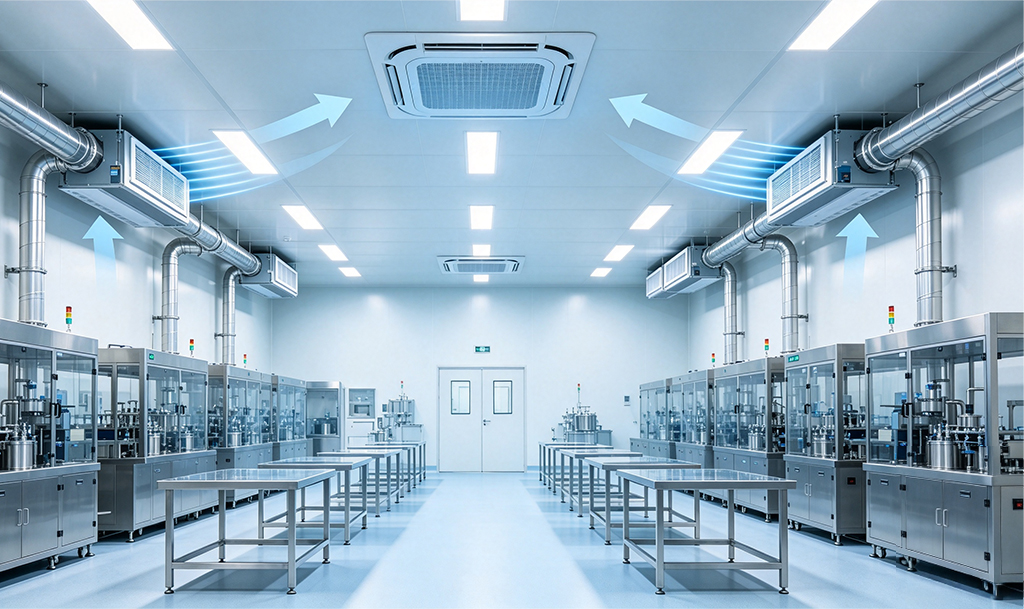
Cleanroom pressure cascades rarely hold their designed values once doors open and filters load. A tighter setup starts with measuring the actual leakage area through door undercuts, penetrations, and wall junctions, then adjusting supply and exhaust offsets so the pressure drop across each boundary sits slightly above the minimum needed to stop backflow—not the generic 15 Pa often copied from old specs.
Instead of chasing a single room pressure, tune the cascade in zones. Trim supply fans or VAV boxes in the outermost rooms first, then work inward, checking that each step doesn't push an adjacent space out of range. Small manual damper changes and recorded door-closing tests reveal how much reserve is really available before alarms trip.
After tuning, set alarm deadbands around observed drift rather than theoretical limits. A well-tuned cascade will hold direction with a few pascals of fluctuation, so operators can spot a failing fan or plugged prefilter early without false alarms. Recheck the offsets seasonally because stack effect and outdoor humidity shift the baseline.
Airflow Calibration Without the Recertification Rush
Maintaining precise airflow in controlled environments often triggers a familiar headache: the moment calibration drifts, the whole recertification cycle kicks in. You end up waiting for scheduled audits, shuffling paperwork, and losing productive hours to a process that feels heavier than the actual fix. There’s a quieter approach, though—one that treats calibration as a routine adjustment rather than a milestone event tied to recertification deadlines.
The idea is straightforward. Technicians carry portable anemometers and micromanometers to the site, measuring face velocities and pressure differentials on the spot. They tweak damper positions, adjust fan speeds, or rebalance supply and exhaust flows without waiting for a formal recertification window. The readings get logged, trends are compared against baseline performance, and any drift is corrected within the same visit. Because the instruments are calibrated independently and the data is timestamped, the adjustment stands on its own merit—no need to rush a full facility recertification just to validate a minor airflow correction.
What this buys you is breathing room. Labs, cleanrooms, and vivariums keep running with minimal disruption. You avoid the scramble of emergency recertification, yet still have defensible records showing that airflow stayed within spec between scheduled audits. It’s a practical middle path: vigilant about performance, relaxed about bureaucracy, and finished before lunch.
Managing Temperature and Humidity Drift Proactively
Temperature and humidity rarely shift suddenly in a controlled space. More often, they slide a little at a time, and by the time an alarm trips, the environment has already been outside the safe range long enough to cause problems. Instead of waiting for that moment, treat drift as something you watch for in the data. Log readings from several points in the room, not just the thermostat, and set warning bands that are deliberately tighter than your alarm thresholds. That way a slow rise or fall gets attention while it is still easy to correct.
Sensor placement and sensor health matter as much as the HVAC settings themselves. A probe mounted near a door, an exterior wall, or a sunny window will report conditions that do not represent the middle of the room where materials are actually stored. Rotate or verify sensors against a known reference every few months, and if the room has proven hot or cold spots, add secondary monitoring there. When you do need to adjust, use staged changes: start with small setpoint shifts or fan speed changes, then reassess after a few hours rather than making a large correction all at once.
Seasonal transitions are the most common time for drift to creep in, but building maintenance schedules can also push things out of balance. If filters get changed, dampers are serviced, or a nearby space changes use, take fresh baseline readings before the room has a chance to stray. Ask the people who work in the space every day to flag anything unusual, such as a change in how the air feels or a new cold draft. Their observations often point to a problem before any automated system catches it.
Why Air Change Rates Deserve a Closer Look
Air change rates often get reduced to a single line in a compliance document, but they shape how a room actually feels. A space with low turnover can trap odors, moisture, and CO2, while one with excessive turnover can feel drafty and waste energy. The number only makes sense when you look at how the room is used day to day.
A closer look also reveals mismatches that standard calculations miss. Two classrooms with identical square footage can have very different needs if one hosts a quiet study hall and the other a chemistry lab. A meeting room that holds eight people for an hour may need a different rate than a break room with constant foot traffic.
Paying attention to these details doesn't mean chasing a perfect constant. It means adjusting the rate to match occupancy patterns, source control, and comfort targets. That kind of tuning usually improves indoor air quality without automatically increasing fan energy—something a fixed, one-size-fits-all number rarely achieves.
Service Documentation That Passes Audits Without the Headache
Most service documentation fails audits not because it lacks information, but because it buries the important stuff under a pile of generic boilerplate. Auditors don't want to flip through forty pages of copy-pasted policies. They want to see a clear trail from each service you offer to the exact steps, controls, and evidence that prove you're doing what you say. Start by writing down the things your team actually does every day—the real workflows, the real checks—and then link each one to the relevant requirement. If a document reads like it was written for a compliance box, it will get picked apart. If it reads like a reflection of how work actually happens, it passes.
The headache usually comes from overdocumenting. People assume more pages mean more thorough. In practice, auditors skim for specific triggers: ownership, change management, incident response, backup testing, access reviews. If each of those has a short, dated, and concrete entry—what changed, who approved it, when it was tested—you're 90% there. Avoid vague verbs like monitor regularly or ensure compliance. Instead, write down that every Tuesday the on-call engineer checks the backup logs and posts a summary in the ops channel. That level of specificity removes doubt and cuts down on follow-up questions.
One trick that works well is to treat your documentation like a changelog, not a novel. Every time you touch a service—deploy a patch, rotate a key, run a failover test—add a one-line entry with the date and a link to the ticket or pull request. Audits love this because it shows a living system, not a static artifact. And when audit season rolls around, you simply export the log instead of spending three weeks reconstructing history from memory. That's how you pass without the late nights.
FAQ
Replacement intervals depend on pressure drop readings and particle counts rather than a fixed calendar schedule. Many facilities plan for annual inspections, but filters may last longer if pre-filtration is effective and the room is not heavily loaded.
Often it's the integrity of ductwork and sealing around terminal housings. Small leaks can allow unfiltered air to bypass the HEPA stage, undermining the entire contamination control strategy even when filters and airflow are within spec.
Positive pressure keeps contaminated air from adjacent less-clean areas from entering the controlled space. If the differential drops, contaminants can infiltrate through doors, pass-throughs, and cable penetrations, leading to product or process failures.
Generally no, because temperature and humidity swings combined with loss of pressure cascade can cause condensation, particle settling, and microbial growth. If setback strategies are used, they require careful validation to ensure recovery time and contamination risk remain acceptable.
It verifies unidirectional airflow patterns and identifies dead zones or turbulence that could trap particles. Regular smoke studies help confirm that the air actually moves as designed, not just that the fan is running and volumes meet the spec on paper.
Continuous monitoring of particle counts, pressure differentials, temperature, and humidity provides the earliest warning. Trending this data against alert and action limits allows operators to catch drift before it becomes an excursion that affects operations.
Certification is a snapshot in time, but HVAC service ensures the conditions that were certified remain stable between re-certifications. Without ongoing maintenance, a cleanroom can pass an annual test yet operate out of compliance for months in between.
Yes, coils should be inspected and cleaned to maintain heat transfer and airflow. Condensate pans must be kept clean and properly sloped to drain because standing water can support microbial growth that then gets distributed into the cleanroom air stream.
Conclusion
Keeping a cleanroom HVAC system dependable calls for a service approach that looks past basic maintenance and digs into the finer points of contamination control. Filter integrity checks, for instance, work best when they are treated as an early-warning routine rather than a periodic formality; scanning for pinholes or gasket leaks before they spread keeps small flaws from turning into batch losses. Pressure cascade tuning is another area where small adjustments pay off—rebalancing room-to-room differentials so air always moves from cleaner zones toward less critical ones prevents backflow and cross-contamination. Airflow calibration also deserves ongoing attention, not just a last-minute push before recertification; steady, measured airflow keeps velocities within spec and avoids the stress of finding drift too late.
Temperature and humidity rarely fail all at once, but gradual drift can quietly affect product stability, static buildup, and even filter performance. Watching trends and correcting setpoints early is far cheaper than reacting after a deviation. Air change rates, too, deserve a closer look: many cleanrooms run at rates that are either wasteful or barely sufficient, and matching the rate to the actual process load improves both cleanliness and energy use. Finally, service documentation should be built as you go, with clear records of each check, adjustment, and calibration. When an audit arrives, having logs that are legible and complete removes the usual headache and shows that contamination control is managed, not assumed.
Contact Us
Contact Person: Amy Yang
Email: [email protected]
Tel/WhatsApp: 008619330882686
Website: https://www.genopharmatech.com/