

Calcium Chloride 94% Flakes Supplier Checklist for Industrial Buyers
2026-11-25
Calcium chloride 94% flakes may look like a straightforward commodity, but industrial buyers know that consistency, purity, and supply reliability can vary sharply from one source to another. A supplier checklist helps cut through marketing noise and focus on what actually affects your production: moisture content, particle size, packaging integrity, and the vendor’s ability to handle peak-season demand. Shouguang Golden Chemical has built its reputation on these practical details, offering clear product specifications and responsive logistics support. In this guide, we break down the key checks that procurement teams should run before committing to a bulk order—so you can avoid costly downtime and qualify suppliers with confidence.
Does That 94% Figure Hold Up Under Testing?
A figure like 94% tends to shut down debate before it really starts. It looks exact, almost clinical, and it gives a claim the atmosphere of settled fact. But the moment you ask what was being measured, the picture gets softer. Was that 94% drawn from everyone who used the product, or from a narrow group that already met a favorable set of conditions? Did the people involved report back after a week, a month, or a year? Those distinctions rarely survive the journey from raw results to a memorable talking point.
Putting the number under pressure means looking past the percentage and into the structure around it. Sample size matters, but so does the dropout rate, the wording of questions, and whether the result could be repeated outside the original setting. Sometimes the claim holds up within a limited definition and collapses as soon as the definition widens. Other times the 94% stays fairly stable even after you remove the most enthusiastic respondents. The value isn't that the number is false or true in a simple sense. It's that a headline percentage usually carries far more confidence than the underlying evidence can justify.
How Much Impurity Is Hiding in the Other 6%?
A 94% purity figure tends to sound reassuring on paper, but that leftover 6% is rarely one clean, harmless substance. It can include residual solvents, unreacted raw materials, moisture, dust, or by-products formed during processing. The real question is not whether those extras are present, but whether anyone has bothered to identify and measure them.
In many cases, the difference between a clean product and a questionable one comes down to how that 6% is distributed. Ten trace compounds at 0.6% each pose a very different set of risks than a single unwanted material at 6%. Without batch-level testing, the label alone leaves plenty of room for uncertainty.
Some manufacturers treat the remaining fraction as an open secret, assuming low amounts won't matter. Others run the full profile and can tell you exactly what is there. If the source cannot explain the 6%, that gap is worth taking seriously, especially when the product is inhaled, swallowed, or applied to skin.
Certificates of Analysis Worth More Than the Paper They Are Printed On
Most certificates of analysis are treated as routine paperwork, but the ones that matter carry details suppliers often prefer not to highlight. A useful CoA goes beyond a batch number and a signature. It names the test method, reports the actual result against the acceptance range, and makes clear whether the data came from an in-house instrument or an outside laboratory. Without those specifics, the document is just a typed version of the product brochure.
Third-party testing changes the weight of a certificate. When the laboratory has no financial interest in the sale, the numbers become harder to wave away. Strong certificates identify the testing facility, state whether methods were compendial or developed in-house, and note any deviations instead of hiding them in abbreviated footnotes. That openness signals that the supplier expects scrutiny rather than hoping for a quick glance.
A certificate earns real value only when it is tied to a specific batch and supported by handling and storage records. If the claims on the page cannot be traced back to raw data, calibration logs, and the people who performed the work, the paper provides no real protection. It should be read as a compact chain of evidence, not as a guarantee printed on company letterhead.
Packaging Decisions That Prevent Caking During Storage
Choosing packaging for powders and granules often comes down to controlling moisture before it turns into a crust. A barrier film alone is rarely enough; the real work happens in the details. Swapping to a foil-lined bag or a multilayer laminate with a metallized layer slows moisture ingress, but if the seal area traps product dust, humidity still finds a way in. Nitrogen flushing after filling pushes out damp air and leaves less moisture available for particle surfaces to absorb. For products that are especially prone to clumping, adding a food-grade desiccant sachet or a moisture scavenger inside the container can handle the residual vapor that sneaks in during temperature swings.
Headspace and portioning also shape how well a powder stays loose. A large empty space above the fill line gives water vapor room to move, so reducing headspace or matching container size to fill volume keeps humidity from pooling near the product. Rigid containers with airtight lids tend to perform better than thin bags in humid warehouses, but they still need a clean, dry filling environment. Some operations use valve bags or one-way degassing valves for fine powders, while others move to single-use sachets so the bulk of the product is not exposed every time the main package is opened. These choices keep caking from becoming a storage problem rather than just a formulation one.
Lead Times, Freight Terms, and the Cost of a Missed Delivery
A promised date on a purchase order is rarely just a date. It carries assumptions about production capacity, warehouse space, and the customer's own commitments further down the chain. When lead times stretch without warning, the immediate reaction is often to point at the supplier, but the real friction usually starts much earlier. A part number that was forecast as stable, a material revision that arrived late, or a freight lane that quietly lost capacity can each pull the delivery date further out. Teams that treat the lead time as a fixed number instead of a shifting signal often discover problems only when the truck is already a day behind schedule.
Freight terms shape how quickly those problems become visible. Buying under FOB origin may look cheaper on paper because the base price excludes the final mile, yet it hands control of the shipment to a carrier selected by the supplier or a forwarder with little reason to prioritize your dock. In contrast, terms that keep routing authority closer to the buyer make it easier to switch modes, hold a shipment for consolidation, or pay for expedited capacity before a short delay becomes a line-down event. The difference is not only about who pays the freight bill. It is about who can act when a container misses a cutoff or a regional carrier runs out of equipment on a Friday afternoon.
A missed delivery, even by a few hours, can unravel schedules that took weeks to align. Production planners may have already scheduled overtime, maintenance may have been pushed back, and a customer's project team may be waiting for one component to close out an installation. The direct charge for rerouting a shipment or air-freighting a pallet is easy to quantify. What gets overlooked is the multiplier effect: expedited freight to recover one order can push other shipments down the priority list, causing a second and third delay elsewhere. Measuring lead time adherence without measuring the cost of recovery misses the point. The more useful habit is to review every near-miss as a pricing signal, because the true cost of a missed delivery is rarely the freight invoice. It is the accumulated cost of planning around unreliable time.
What a Plant Walkthrough Reveals About a Supplier
Walking the floor tells you more in twenty minutes than a stack of audit reports ever will. It starts with the small things: whether the aisles are cluttered or clear, whether the calibration stickers on gauges are current, whether workers look up and make eye contact or keep their heads down. These details aren't in the standard supplier questionnaire, but they speak directly to how the place is managed day to day. A supplier that keeps raw material bins labeled and segregated, with first-in-first-out rotation actually followed, is one that takes process discipline seriously. If you see scrap piled next to a machine without a clear reason or a red-tag area overflowing, you're probably seeing a pattern of unresolved problems rather than an isolated bad day.
Pay attention to how information moves between people. A strong supplier doesn't just have a bright, modern control board at the entrance; they can point to someone on the line who can explain what the board means and what was done about last week's shortfall. Ask a machine operator what happens when they find a defect. If the answer is “I call my supervisor,” that's one level of maturity. If the answer is “I stop the line, tag it, and write it on the board,” that's another. The walkthrough reveals whether problem-solving is pushed down to the people closest to the work or hoarded in the quality office. You can also spot the truth about maintenance culture—look under the guards, not just at the painted surfaces. Oil leaks, makeshift repairs, and missing bolts are honest signals that preventive maintenance exists on paper more than in practice.
Finally, watch how people treat each other and the product. A supervisor who talks to an operator with respect, or an engineer who kneels to inspect a fixture, tells you about the daily working climate that will shape your parts. Notice whether inspectors actually use the gages at their stations or keep them in a drawer for customer visits. Check the lighting over assembly areas, the condition of torque wrenches, and whether rejected material is clearly separated from good stock. These observations don't require a deep technical background. They require curiosity and a willingness to look beyond the conference room slides. A thorough walkthrough often reveals more about a supplier's reliability, honesty, and capacity to improve than any third-party certification can.
FAQ
Look at the certificate of analysis for a recent production batch instead of relying only on the printed specification. Pay attention to actual calcium chloride content, moisture, magnesium and alkali metal chlorides, and water-insoluble matter. These numbers show whether the 94% claim holds up under your own process conditions.
Request a sieve analysis and ask what anti-caking treatment is used. Flakes with excessive fines tend to absorb humidity faster and can bridge or clog discharge equipment. If the material will sit in an unheated warehouse or move through humid regions, ask for a moisture pickup test under similar conditions.
Magnesium and alkali metal chlorides are usually the ones to watch. In brine preparation or de-icing work, elevated magnesium can change freezing point behavior and leave surface residue. Set explicit limits for these impurities and for water-insoluble solids rather than accepting only a total assay number.
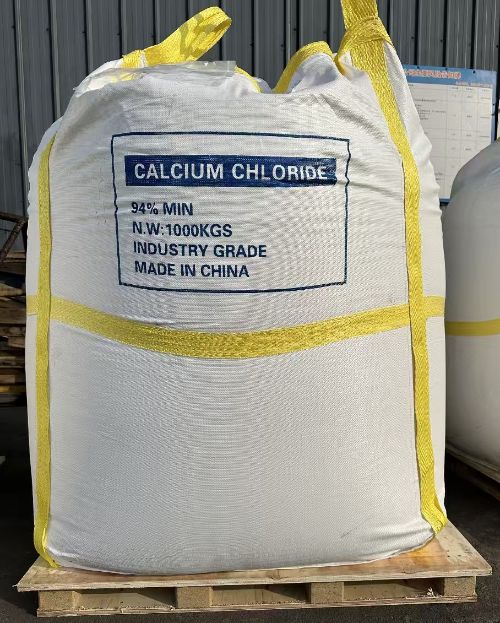
Confirm available formats such as 25 kg bags, 500 kg supersacks, or bulk trucks, and check pallet type, liner material, and whether the supplier shrink-wraps ocean freight. Ask how they protect the product from moisture during transit and whether they can share loading photos or reference shipments to your region.
For recurring container loads, a remote or on-site audit is usually worth the effort. Focus on drying, screening, sampling, and quality control rather than a general factory tour. It gives you a clearer sense of whether the 94% specification comes from consistent production or from a selected sample.
Ask for a product data sheet, safety data sheet, a recent certificate of analysis, and batch-to-batch variation data from at least three production runs. If your application requires food-grade or NSF certification, have those documents reviewed before the order is placed.
Compare landed cost per dry ton instead of price per metric ton as-packaged. Adjust for moisture content, expected packaging loss, delivery reliability, and technical support. A lower initial quote can easily become more expensive after handling problems, slower dissolving, or inconsistent supply.
Conclusion
A 94% calcium chloride flake specification is only as good as the evidence behind it, so push suppliers for retained samples, recent independent assays, and a clear explanation of how that number is measured. The other 6% can quietly alter melting speed, accelerate corrosion, or leave residue in storage tanks, which means buyers should review the full typical analysis rather than chasing the headline purity. A certificate of analysis is easy to print and easy to falsify; it only carries weight when tied to the actual lot, signed by a real lab, and matched to the supplier’s internal batch records. Packaging matters long after the truck leaves the dock, so sealed liners, sturdy bags, pallet wrap, and covered storage all play a role in preventing caking and keeping the material free-flowing when it reaches your crew.
Logistics failures can wipe out any savings from a lower quote, so clarify lead times, freight responsibility, and the supplier’s plan for weather delays or rejected loads before issuing a purchase order. A supplier with weak scheduling discipline will pass that uncertainty on to your operation. When possible, visit the plant and watch how material is screened, loaded, and stored; damp floors, open bags, and sloppy labeling usually predict the kind of inconsistency that no certificate can fix. The checklist comes down to verifying purity claims, understanding impurities, trusting documentation only after confirmation, protecting product through packaging, holding suppliers accountable for delivery, and letting the physical plant tell you what the data leaves out.
Contact Us
Contact Person: Tom Cui
Email: [email protected]
Tel/WhatsApp: +8618663670626
Website: https://www.jinjigoldenchem.com