

Best Oil-Filled Pressure Gauge Options for Reliable Performance in Harsh Conditions
2026-11-19
A dry gauge might survive a clean control room, but expose it to vibration, moisture, or sudden pressure spikes and the reading becomes a guess. Oil-filled pressure gauges exist for exactly that moment: the liquid dampens shock, lubricates internal parts, and keeps the dial steady when conditions turn rough. Still, not every oil-filled option is built the same. Here, HONGSEN stands out as a dependable choice for tough installations where accuracy cannot be left to chance. If you are weighing your options for reliable performance in harsh environments, this guide breaks down what matters before you buy.
What Separates Oil-Filled Gauges From Dry Designs in Rough Service
In rough service environments, the difference between oil-filled and dry pressure gauges comes down to how each handles vibration, pulsation, and sudden shocks. A dry gauge has nothing inside the case except air, so the needle can bounce wildly when a pump cycles or a compressor kicks in. That constant movement wears out the gear teeth and linkage, eventually causing readings to drift or the mechanism to fail outright. An oil-filled gauge, by contrast, uses a viscous fluid—usually glycerin or silicone—to dampen that motion. The needle settles quickly onto the true pressure instead of fluttering, which means the operator sees a stable value and the internal parts survive far longer.
Another separation point is how each design protects against moisture and condensation. Dry gauges in outdoor or washdown locations often develop fog on the inside of the lens, and over time that trapped humidity can corrode the bourdon tube or fog the dial permanently. Oil-filled gauges fill the entire case, leaving no air space for condensation to form. The fluid also acts as a continuous lubricant for the moving parts, which is a big advantage when the gauge is mounted near hammering equipment or on a panel that sees constant low-level vibration. You sacrifice a bit of readability at extreme temperatures—oil thickens in the cold—but for most rough-duty applications that trade-off is worth it.
It is also worth noting that oil-filled gauges handle pressure spikes differently. When a system experiences a sudden surge, the fluid absorbs some of the kinetic energy before it reaches the bourdon tube. This reduces the risk of the tube being bent past its elastic limit, a common failure mode in dry gauges used on hydraulic presses or logging equipment. The fluid does add some maintenance overhead—you need to check for leaks around the fill plug and occasionally top off the case—but for anyone who has replaced a dry gauge three times in a year, that extra step feels minor compared to the extended service life.
Dial Damping That Keeps Needles Steady Under Constant Vibration
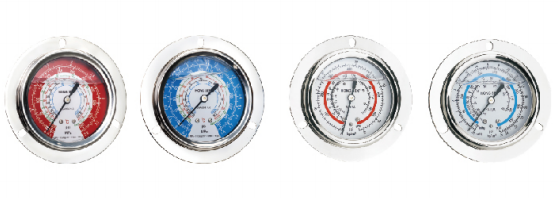
Constant vibration is the quiet enemy of precision. Whether it's a motorcycle engine humming through the frame or industrial machinery shaking a workbench, standard damping methods often overcorrect, leaving the needle sluggish or drifting. The trick lies in matching the damping rate to the vibration frequency rather than simply increasing resistance. By tuning the mechanism so that only high-frequency oscillations are absorbed while low-frequency steering remains responsive, the needle holds steady without feeling sticky.
What makes this approach stand out is its passive nature. No electronics, no active compensation; just careful geometry and fluid selection working together. A narrow clearance gap paired with a medium-viscosity damping fluid creates a natural low-pass filter. The result is a gauge that reads clearly on a running engine yet still responds instantly when conditions change, because the damping can't overreact—it only cancels the specific jitter it was built for.
Installation rarely requires re-engineering the whole meter. Often a simple swap of the pivot bushing or a revised needle counterweight is enough to shift the system's resonance away from the vibration band. Mechanics who test this in the field notice the biggest difference at idle and mid-range RPMs, where traditional needle flutter is worst. The dial looks almost frozen by comparison, yet a quick throttle blip still produces that familiar, immediate sweep.
Choosing a Case and Window That Can Handle Moisture, Dust, and Impact
Enclosures that cope with moisture and dust do not depend on gasket material alone. Look for a sealing lip with steady compression around the full opening, coated or stainless hardware that will not draw water into the cutout, and a window bed that keeps the panel from touching sharp edges. Polycarbonate is usually a better window choice than acrylic in these settings because it holds up to frequent wiping and does not craze as quickly when exposed to fine grit.
Impact resistance is less about raw thickness and more about how the window is supported. A moderately thick polycarbonate pane with proper edge clearance and a compressible gasket can absorb knocks better than a heavy acrylic sheet bolted tightly near its corners. Avoid drilled holes that sit too close to the edge, and choose a mounting style that spreads load across the frame instead of concentrating it at a few screws.
The most dependable setups treat the case and window as one sealed assembly. The bezel, gasket, and transparent panel should be sized together so the gasket compresses evenly without squeezing out or pinching the window. Before specifying a combination, test or request evidence for the full assembly under dust, washdown, and repeated impact, since a strong housing with a poorly seated window will fail at the place everyone overlooks.
Temperature Swings and Why Glycerin-Filled Housings Stay Accurate
Most pressure gauges rely on a thin metal tube that bends as pressure changes. In cold weather, that tube can stiffen, and in heat it may expand unevenly. Glycerin-filled housings don't eliminate those physical shifts, but they do slow them down. The liquid surrounds the internal mechanism, absorbing sudden temperature swings before they reach the sensing element. That buffer means the gauge reads the actual pressure, not a spike caused by a cold snap or a heat wave.
Without glycerin, a gauge exposed to direct sunlight can drift several percent within minutes. The needle may climb even though line pressure hasn't changed. With the housing filled, the fluid acts as a thermal mass. It holds the internal parts at a more uniform temperature, reducing the mismatch between the bourdon tube and the linkage. That keeps the needle steady and the reading trustworthy, even when the ambient temperature bounces between freezing nights and hot afternoons.
There's also a mechanical dampening effect that matters more than people expect. Rapid temperature changes often come with vibration or pulsation, and glycerin absorbs both. A dry gauge can jitter and wear out its pivot points. A filled gauge moves smoothly, so the operator isn't chasing a needle that jumps every time the sun goes behind a cloud. Over months of outdoor service, that steadiness adds up to fewer false alarms and fewer recalibrations.
Pressure Ranges and Connection Types Worth Considering Before You Buy
Most buyers jump straight to the pressure rating without realizing how much the connection type shapes real-world usability. A gauge that reads perfectly on a bench can become a headache on-site if the thread pitch or sealing method doesn't match your existing setup. NPT, BSP, and metric fittings all behave differently under vibration and thermal cycling, and an adapter stack usually introduces a new leak point rather than solving the problem. Before committing to a specific range, check what the rest of your system already uses and what replacement parts are actually available locally.
Pressure range selection also deserves more nuance than simply picking the widest span. A sensor sized for 0 to 500 psi may be nearly useless for a system that operates at 15 to 30 psi, because the resolution and accuracy at the low end often fall apart. Conversely, running a transducer at the very top of its range on a regular basis shortens its life and can cause zero drift. Look at where the needle spends most of its time, then choose a range where that sits in the middle third, not at the extremes.
Finally, think about how the connection and the pressure envelope interact with maintenance routines. A welded diaphragm seal may offer great chemical compatibility but becomes expensive to replace if clogging is common. Threaded connections with a removable snubber or isolation valve give you more flexibility during commissioning and troubleshooting. Whatever combination you lean toward, test one unit in the actual operating environment before standardizing across the whole facility.
Field Notes: Models That Hold Up in Compressors, Pumps, and Hydraulics
A pump skid near the back of the plant has been running the same drive unit for nearly nine years now. The housing shows the usual scuffs and a few layers of overspray, but the bearing seats and shaft runout still check within spec whenever we pull it for inspection. That kind of predictability matters more than a glossy spec sheet.
On the hydraulic side, the smaller fixed-displacement motors tend to get ignored until a hose lets go. The models that hold up are usually the ones with simple porting and enough case drain capacity to keep internal pressure from eating the shaft seal. We have swapped a few over to heavier oil just to see them run quieter under load.
Compressor duty is where weak castings and undersized fasteners show up first. The units that survive cyclic loading here are heavier in the frame and use bearing arrangements that do not rely on perfect alignment. It is not unusual to see them outlast two or three rebuilds of the compressor itself.
FAQ
On a pump skid, constant pulsation wears down a dry gauge movement quickly. The fill fluid dampens needle flutter, reduces gear wear, and keeps the pointer readable even when vibration is steady. It also protects internals from condensation and minor corrosion.
Look for a case vent or relief valve and a fill fluid suited to the temperature range, often silicone or glycerin. Rapid swings can build internal pressure, so a vented case prevents the lens from popping or leaking at the plug. Silicone usually performs better across wider temperature spans.
Not always, but they are worth it near salt spray, frequent washdowns, or chemical exposure. A stainless or powder-coated steel case resists corrosion better than plain painted steel. If the environment is mostly wet and dirty but not chemically aggressive, a well-sealed brass or coated case can work.
Glycerin can thicken in freezing temperatures, making the needle lag or respond slowly. Silicone stays more stable across a broader temperature range and is often preferred for outdoor or refrigerated systems. For very low temperatures, a low-viscosity silicone or a specialized fill may be needed.
1/4-inch NPT is common for many industrial gauges, but 1/2-inch NPT shows up on larger or high-vibration installations. Match the connection to the process port rather than stacking multiple adapters, because extra fittings can introduce leak points and amplify vibration.
Yes, if it is rated for the pressure and has a restrictor or snubber when pressure spikes are severe. The oil fill handles normal pump ripple, but a snubber adds protection against sudden shock loads. Make sure the wetted parts are compatible with the hydraulic fluid.
Small bubbles often form during shipping or temperature changes and typically do not affect function. You can let the gauge sit upright or slightly open the fill plug to normalize internal pressure, but avoid opening it in wet or dirty environments unless necessary.
Conclusion
Oil-filled gauges earn their place in harsh service because the fluid inside does more than resist moisture. When a pump or compressor transmits constant vibration through the mounting point, a dry movement can chatter and wear quickly; in a glycerin- or silicone-filled housing the fluid cushions the needle and internal links, so readings stay readable instead of blurring into a twitch. That damping effect also protects the bourdon tube from rapid pressure spikes, which is useful on hydraulic circuits and reciprocating compressors. The case and lens matter just as much: a stainless or powder-coated body with a thick acrylic or glass window keeps dust, spray, and the occasional impact from turning a gauge into a liability.
Temperature swings are another reason to choose a filled gauge carefully. Glycerin works well in moderate ranges, while silicone suits colder or hotter installations without thickening too much. Before buying, look beyond the dial: match the pressure range so normal operation sits near the middle of the scale, and confirm the connection thread, size, and orientation fit the existing port. In field use across compressors, pumps, and hydraulic power units, the most dependable models combine a sealed case, a blowout back or relief plug, and a movement that tolerates pulsation. That combination keeps the instrument consistent even when the surrounding equipment is not.
Contact Us
Contact Person: KOPASS HO
Email: [email protected]
Tel/WhatsApp: 8613606566112
Website: https://www.hongsenref.com/