
Anodizing Equipment Solutions That Improve Production Efficiency
2026-08-24
Production efficiency isn't about running your rectifier harder—it's about eliminating the silent drags that add minutes to every load. At Junda, we've seen too many anodizing lines lose throughput to uneven current distribution, sluggish rinses, and tank layouts that fight the workflow instead of following it. In this piece, we'll look at the equipment upgrades that actually shorten cycle times and improve coating consistency, so you can decide what's worth changing on your floor. If you've ever suspected your line could do more without adding tanks or staff, keep reading.
Rethinking Line Layout for a Smoother Anodizing Workflow
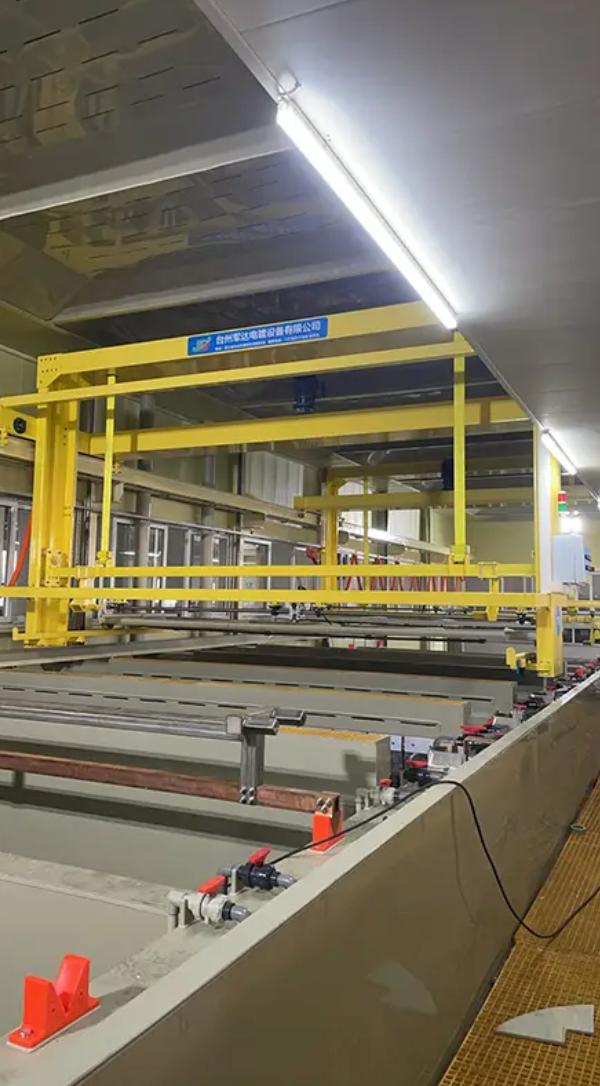
Traditional anodizing lines often force parts through a rigid sequence of tanks, but a critical look at how those tanks are arranged can uncover surprising bottlenecks. Instead of treating the layout as fixed, consider grouping process stages by shared utilities and material flow. For example, placing the rinse station immediately after the etch tank reduces carry-over and shortens transfer time, while a dedicated unload zone away from chemical handling keeps operators moving with less hesitation.
A smoother workflow also depends on how racks and fixtures travel between stations. Angled transfer aisles or a simple overhead monorail loop can eliminate the awkward cross-traffic that slows down manual lines. Even small changes, like rotating a tank 90 degrees to shorten reach distance or adding a buffer station for rack staging, can flatten the peaks and valleys of daily throughput without adding new equipment.
The goal isn't just faster cycling—it's fewer interruptions and a predictable rhythm. When the line layout supports one-direction movement, visual inspection points, and easy access for maintenance, operators spend less time waiting and more time processing quality parts. Rethinking the layout in this way turns anodizing from a series of disconnected steps into a continuous, low-friction flow.
Smarter Rectifiers That Cut Energy Waste and Shorten Cycle Times
Traditional rectifiers waste a surprising amount of energy as heat, especially under partial loads. Modern "smart" rectifiers solve this by continuously monitoring input voltage and output demand, adjusting switching timing on the fly. Instead of a fixed bridge that always drops the same voltage, these units use adaptive gate drive and synchronous rectification to keep conduction losses minimal. The result is less waste heat, smaller cooling hardware, and a noticeable drop in electricity bills over the unit's lifetime.
Beyond energy savings, smarter rectifiers also shorten cycle times in industrial processes. By responding to load changes within microseconds rather than milliseconds, they maintain tighter voltage regulation during rapid acceleration or heavy inrush currents. This stability lets motors, plating baths, or battery chargers reach target parameters sooner, without waiting for voltage to recover. Fewer interruptions and faster settling mean production lines can run at higher throughput with the same equipment.
Automation Touchpoints That Remove Bottlenecks Without Overcomplicating the Floor
On many floors, the biggest slowdowns come from small, repetitive touches that were never designed for volume. Adding automation doesn’t have to mean ripping out every station or hiring a systems integrator. It often works better to focus on the exact points where work queues up—like a manual weight check that backs up packing, or a label peel-and-stick step that forces operators to stop every few seconds. Inserting a compact inline scale with auto-capture and a print-and-apply labeler at those spots can eliminate the wait without turning the line into a robotics showcase.
Another useful touchpoint is the handoff between picking and packing, where misreads or missing scans force rework downstream. A fixed scanner or vision system that reads multiple barcodes at once—no trigger pull, no alignment—lets workers keep both hands on the product. Similarly, replacing a paper-based sorting cue with light-directed put walls or simple diverters removes the mental overhead of “which tote does this go in?” while preserving the physical layout teams already know. The goal is not to automate everything, but to automate the pauses.
The best implementations stay invisible to the floor: no new dashboards to monitor, no complex recipes to switch between SKUs, no lockout when the network hiccups. Choose devices that fail in a predictable way—if the scanner goes down, people can still scan with a handheld or key in the code. That resilience matters more than a 2% speed gain. When automation removes a bottleneck while still letting an experienced operator override or adjust on the fly, it earns trust instead of resentment. That’s the difference between a tool and a headache.
Tank and Rack Design Choices That Speed Up Rinsing and Reduce Drag-Out
Rinse tanks that rely on a simple single overflow often leave a thin, concentrated film on parts because the contaminated water near the surface gets recirculated. Shifting the inlet to the bottom and using a weir that skims the top layer changes the flow pattern enough that dissolved salts are pushed upward and out instead of hanging around the work. Adding a low-pressure air sparge or a pump-driven eductor along one side breaks up the viscous boundary layer on complex shapes, which is often the hidden reason a rinse looks clean but still carries drag-out into the next tank.
On the rack side, the difference between a design that drains well and one that traps solution comes down to how the parts sit relative to the liquid surface. Angling cups, blind holes, or recessed features so they can empty before the rack leaves the tank prevents a surprisingly large amount of solution from being carried out. Small drain holes near the lowest point of tubular or box-section rack members, plus avoiding overlapping flat surfaces that create capillary gaps, keep the rack itself from acting like a sponge. Even a slight tilt of the entire rack during withdrawal, combined with a pause just above the solution, gives trapped liquid time to flow back into the tank rather than dripping onto the floor or into the next process.
Real-Time Process Controls That Let Operators Adjust Before Problems Escalate
Modern production environments can't afford to wait for a batch failure or a sudden shutdown to reveal a drift in critical parameters. The value of real-time process controls lies in their ability to give operators a live, granular view of what's happening inside the line—not a log of what already went wrong. Instead of reacting to alarms after a threshold has been crossed, teams can watch variables like temperature, pressure, flow rate, and viscosity move on dynamic dashboards. When a trend starts heading toward a boundary, a subtle visual cue or a soft alert lets the operator make a small adjustment: nudge a valve, tweak a setpoint, or adjust a feed rate. That early intervention keeps the process within its safe operating window, preventing minor deviation from building into a costly quality issue or an unplanned stop.
The real differentiator is not just the speed of data delivery, but the way that data is translated into actionable context. Rather than drowning operators in raw numbers or flashing red indicators, good real-time control systems layer historical patterns, expected ranges, and predictive hints directly onto the current state. An operator can see, for example, that a reactor's exotherm is climbing faster than usual for this stage of the batch—even though it hasn't hit the alarm limit. With that insight, they can preemptively increase cooling or slow the addition of a reagent. This shifts the operator's role from firefighting to fine-tuning, and it turns the control system into a partner that respects human judgment instead of replacing it. The result is smoother operation, longer equipment life, and a team that feels more in command of the process.
Implementing this kind of responsiveness doesn't demand a complete overhaul of the existing control architecture. Often, it starts with better data integration: pulling signals from existing sensors, adding a few strategic measurement points where blind spots exist, and making that information accessible through a clean, customizable interface. It's less about installing a monolithic "smart" system and more about giving operators the right lens for the moments that matter. When a shift supervisor can glance at a trend line and say, "That looks like the same pattern we saw before the nozzle clogged last month," and then act while there's still time to prevent it, the value becomes self-evident. Real-time process controls, at their best, don't just catch problems—they create the breathing room to avoid them altogether.
Maintenance-Friendly Builds That Keep Anodizing Lines Running Longer
Anodizing lines don't fail suddenly—they degrade in small, predictable ways that most teams ignore until a weekend shutdown turns into a three-day scramble. The builds that keep running longer aren't just tougher; they're deliberately shaped around how people actually maintain them. Think accessible valve clusters instead of pipe mazes, and drain points that don't require a mirror and a prayer. When every rinse tank, rectifier connection, and agitation mechanism is positioned for a technician to reach without disassembling half the line, small fixes happen before they become shutdowns.
A maintenance-friendly anodizing setup starts with material choices that fight the process itself. Acid mist, caustic drag-out, and constant moisture eat standard fasteners and frames within months. Upgrading to polypropylene or PVDF components in high-exposure zones, using sealed bearings on hoists, and spec'ing stainless hardware with isolated washers cuts the corrosion-driven failure cycle dramatically. But the real difference comes from modular design—quick-release spray bars, slide-out heat exchangers, and tank liners that can be swapped without cutting welds. These aren't luxury add-ons; they're the difference between a thirty-minute repair and a day of cutting, grinding, and re-welding.
The payoff shows up in metrics that matter: unscheduled downtime drops, bath chemistry stays more stable because minor leaks and contamination are caught early, and the line's overall service life stretches years beyond the industry average. Teams that run maintenance-friendly builds stop treating upkeep as a necessary evil and start seeing it as a design input. What emerges is a line that doesn't just survive the acid and the amps—it practically tells you when it needs attention, long before the rectifier faults or a tank seam lets go.
FAQ
Rectifier output limits, undersized chillers, and manual hoist scheduling tend to create the biggest slowdowns. Upgrading to higher-current rectifiers with tighter ripple control, adding cooling capacity matched to peak load, and switching to programmable hoists can remove these constraints without expanding the physical footprint.
Automated hoists eliminate the pause-and-decide gaps that come with manual operation. They move parts along a pre-set route, control dwell times precisely, and can stagger multiple loads so tanks rarely sit idle. In many lines, that alone cuts 10–20% off total process time.
Look for switch-mode rectifiers with low ripple, constant current/voltage control, and automatic ramping. Low ripple prevents burning at high current densities, automatic ramping avoids current spikes when parts enter the bath, and constant control keeps coating thickness uniform from load to load.
Many operators assume agitation is only about temperature uniformity, but it also affects oxide growth rate and surface quality. Poor agitation creates hot spots near the parts, which can force you to run at lower current densities to avoid defects. Upgrading to eductor-style or air sparging systems matched to tank geometry often lets you push higher current safely.
Anodizing generates a lot of heat, and if you can't remove it fast enough, the bath temperature climbs above the ideal range. That forces either slower processing or rejects from soft, powdery coatings. Correctly sized exchangers keep temperature within a narrow band, so you can run at maximum current density without interruption.
Yes, if the original design uses modular tanks, bus bars, and power distribution. You can often add extra process tanks or extend rectifier capacity by paralleling modules during a brief maintenance window. Full shutdown is rarely needed for incremental expansion.
They turn guesswork into hard numbers. Tracking current, voltage, temperature, and hoist timing per load shows exactly where delays or deviations happen. Operators can then adjust recipes, spot underperforming rectifiers, or identify tanks that need maintenance before they cause a production slowdown.
Regular checks on bus bar connections, rectifier cooling fans, agitation nozzles, and heat exchanger surfaces make a noticeable difference. Loose connections and clogged nozzles quietly reduce current delivery and bath circulation. A monthly checklist tied to running hours often prevents the slow drift in performance that goes unnoticed until throughput drops.
Conclusion
Shifting how an anodizing line is arranged often uncovers more throughput than adding extra tanks ever will. When load/unload zones sit apart from process baths and parts move in one direction without backtracking, crane wait times shrink and operators stop working around their own shadows. Pair that layout rethink with rectifiers that ramp current based on actual load rather than a fixed schedule, and you cut both energy bills and the minutes spent waiting for a full ramp. Small automation additions, like a sensor that confirms rack contact before rectifier start or a lift that stages the next flight bar, remove the pauses that rarely show up on a process sheet but quietly eat hours every week.
On the wet side, tank and rack details matter more than most people expect. Deeper drain boards, angled rack tips, and barrel-style rinses with air agitation all speed up drag-out recovery and cut rinsing time without adding labor. Real-time conductivity, temperature, and voltage readouts give operators a chance to nudge a bath before a load turns dull or burns, rather than reacting after the damage is done. And when equipment is built with quick-release anode bars, accessible pump unions, and standardized spare parts, scheduled maintenance drops from a full shift to a few focused hours. Each of these changes is modest on its own; together they reshape an anodizing line into a system that runs faster, wastes less, and keeps operators in control.
Contact Us
Contact Person: hayyr
Email: [email protected]
Tel/WhatsApp: 8613082110525
Website: https://www.jundaelectroplating.com